
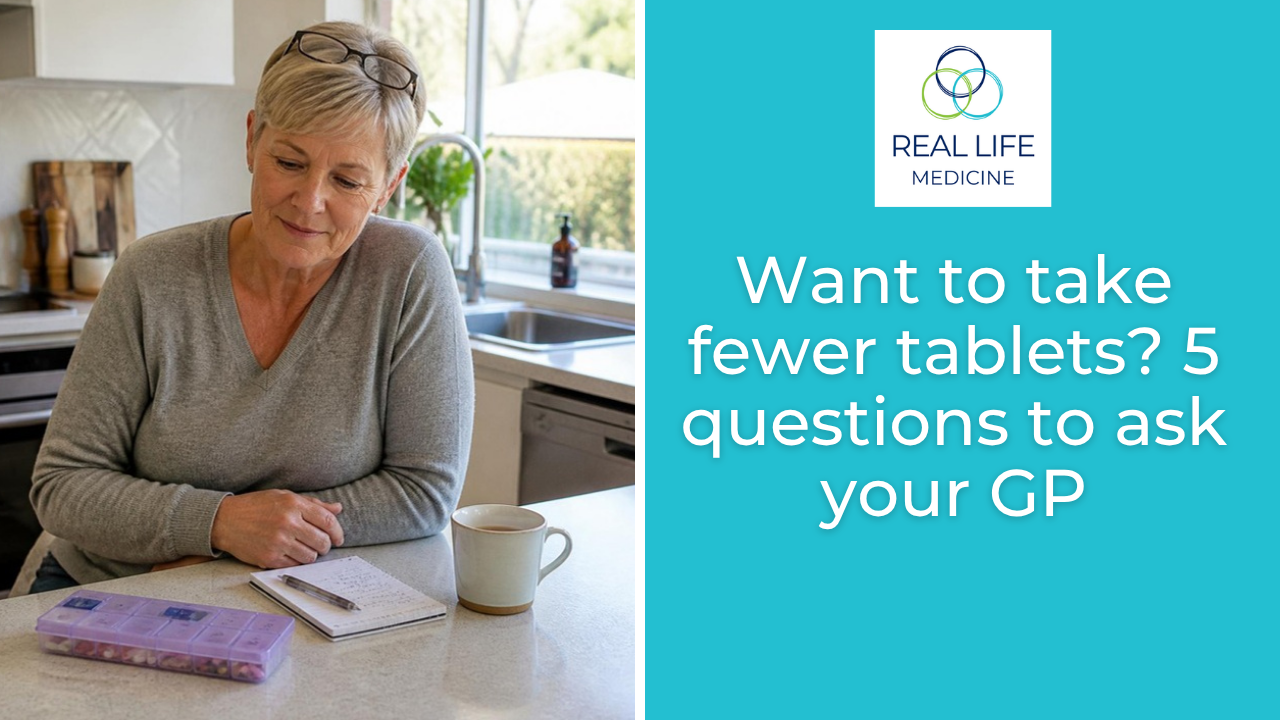
Want to take fewer tablets? 5 questions to ask your GP
Oct 30, 2026Some medications for diabetes, blood pressure and reflux can sometimes be reduced alongside lifestyle change. Here's what the research says, why you never stop on your own, and what to track before your next appointment.
By Dr Lucy Burns and Dr Mary Barson, medical doctors and co-founders of Real Life Medicine. October 2026.
It's Sunday night and you're at the kitchen bench filling the pill organiser. Seven little lids, Monday to Sunday. The blood pressure tablet. The diabetes one. The reflux capsule you started "for a few weeks" back in 2019. As you snap the last lid shut, a thought pops up: when did I become a woman with a pill organiser?
And then the bigger one. Do I still need all of these?
It's one of the questions we hear most. Lots of women tell us they'd love to take fewer tablets. Some worry about side effects or cost. Some have changed how they eat and move, and they're wondering whether their body has changed too. And some feel that every new script is proof they've left it too late. (You haven't, and needing a medication isn't a failure.)
Here's the honest answer up front: we can't promise anyone will come off a medication. Some people reduce or stop one with their doctor's help. Others don't, and for many people staying on a medication is the right call. But it's a fair question, and your GP is the right person to ask. This week we'll help you ask it well.
The short answer: five questions to take to your GP about your medications.
- Why am I taking each of these, and is it still the right dose?
- Will my diabetes medication have to change if I change how I eat?
- What’s the plan if my blood pressure comes down?
- Can I step down my reflux medication, and how do we do it?
- What would be useful to track before we review this?
Why this matters
Medications tend to pile up as the years go on. In a national sample of almost 500,000 Australians dispensed heart and blood pressure medicines (median age 67), nearly three in four people aged 65 and over were on at least two of them. Almost one in three women was also dispensed a reflux medicine. And more than half of the women had more than one doctor prescribing their medicines.
That last one matters. When several doctors are involved, it's easy for a medication to keep rolling on, script after script, without anyone stopping to ask whether it's still needed at the same dose.
Australia's new deprescribing guidelines for older people, published this year in the Medical Journal of Australia, make exactly this point. They note that treatment guidelines rarely say when to stop a medicine, so medicines are often continued indefinitely without a plan. The guidelines encourage prescribers to consider whether a medicine is still needed each time a script is renewed, and to make decisions with the person, based on their goals.
That process has a name: deprescribing. It means reviewing your medicines with your doctor and reducing or stopping the ones you no longer need, in a planned way. It isn't about taking medicines away. It's about making sure each one is still earning its place in the pill organiser.
Before we start: why you never stop on your own
If you take one thing from this post, make it this. Please don't stop, skip, or halve a medication without talking to the doctor who prescribed it. Here's why.
Feeling well might be the medication working. Normal blood pressure on a tablet doesn't tell you what your blood pressure would be without it.
Some medications bounce back. Stopping some medicines suddenly can make symptoms come roaring back, sometimes worse than before. Reflux medications are a good example (more on that in question 4), and some blood pressure medications, such as beta blockers, are usually reduced slowly rather than stopped all at once.
One tablet can do more than one job. Some blood pressure medicines are also prescribed to protect the kidneys, support the heart after a heart attack, or control heart rhythm. Your GP knows which job yours is doing.
Changing how you eat can change what dose is safe. If you cut back on carbs while you're on certain diabetes medicines, your blood sugar can drop too low. This is the big one, and it's why it's so important to tell your GP before you change things, not after.
The flip side is good news. Lifestyle changes can sometimes mean you need less medication, and the safe way to find out is together with your doctor.
This post covers three types of medication that can sometimes change alongside lifestyle change: diabetes, blood pressure, and reflux. It doesn't cover others, such as statins, blood thinners, thyroid medicines, or antidepressants, which come with their own conversations.
Five questions to ask your GP about your medications
1. "Why am I taking each of these, and is it still the right dose?"
This is the starting question, and it's a perfectly reasonable one. A good GP will be glad you asked.
Bring everything you take to the appointment. That includes the over-the-counter things (like reflux tablets from the supermarket) and any supplements. Many pharmacies can print a list of what's been dispensed to you, which is handy if you've got more than one prescriber.
Then go through them one by one:
- What is this one for?
- Is it still doing that job?
- Is this still the right dose for me now?
- What would happen if we reduced it?
Tell your GP your goal out loud. "I'd like to be on fewer medications if it's safe" is a perfectly good thing to say. The Australian deprescribing guidelines are built around shared decisions that reflect your goals, so your goals belong in the conversation.
You can also ask whether a medication review with a pharmacist is an option for you. Pharmacists know medicines inside out and can spot doubling up or interactions.
2. "If I change how I eat, will my diabetes medication have to change?"
Type 2 diabetes has long been described as a condition that only goes one way: more tablets, then insulin. The research shows that for some people, that's not the whole story.
In the DiRECT trial in the UK, adults aged 20 to 65 who'd been diagnosed with type 2 diabetes in the past six years (and weren't on insulin) were offered a structured weight loss program using meal-replacement shakes, with ongoing support. Their diabetes and blood pressure medicines were stopped at the start, under medical supervision. After a year, 46% were in remission, meaning their blood sugar was below the diabetes range without any diabetes medication. In the comparison group, it was 4%. Remission was much more likely with more weight lost.
A different approach comes from a general practice in Southport, England, where GPs have offered a lower carb diet to people with type 2 diabetes since 2013. Of the 186 people who chose it, followed for an average of nearly three years, 51% achieved drug-free remission. That was 77% for people who'd had diabetes for less than a year, falling to 20% for people who'd had it for more than 15 years. Their average HbA1c (a measure of blood sugar over the past few months) fell from 63 to 46 mmol/mol. This was one practice, looking at people who chose the approach, rather than a randomised trial. But it's real-world general practice, and it's hopeful.
And if you've had diabetes for a long time? The same practice found that people with the most poorly controlled diabetes had the biggest improvements in their blood sugar, even when they didn't reach remission. Less medication and better control both count.
The safety part. If you're on insulin or a sulfonylurea (such as gliclazide), eating fewer carbs can make your blood sugar drop too low, sometimes within days. That's why doctors have published practical guides on adjusting diabetes medicines for people eating lower carb. If you're on an SGLT2 inhibitor (such as empagliflozin or dapagliflozin), a very low carb diet can increase the risk of a rare but serious condition called ketoacidosis. Doctors in Hobart have reported a case of exactly this in the Medical Journal of Australia.
None of this means you can't change how you eat. It means talking to your GP before you start, so they can adjust your medication with you.
Questions to ask:
- If I eat fewer carbs, which of my medicines might have to change first?
- What blood sugar readings would tell us it's time to adjust?
- What are the signs of a low blood sugar, and what do I do?
- Could remission be possible for me, and what would that look like?
If you're wondering whether insulin resistance is part of your picture, our post on the early signs of insulin resistance is a good place to start.
3. "If my blood pressure comes down, how will we know, and what's the plan?"
When people improve their metabolic health, blood pressure often comes down too. In the Southport practice we mentioned above, average systolic blood pressure (the top number) fell by 12 mmHg in people following the lower carb approach. We covered the "why" in our post on five ways to lower your blood pressure, including the link between insulin and the way your kidneys hold onto sodium.
So what happens to the tablets? Reducing blood pressure medication under supervision is a recognised part of medical care. In the OPTiMISE trial in England, 569 people aged 80 and over whose blood pressure was well controlled on two or more medicines were randomly assigned to either have one medicine removed by their GP, or carry on as usual. After about four years, around half of the people still alive in the reduction group were still on fewer medicines, and there was no increase in hospital admissions or deaths compared with usual care.
That trial was in people much older than most of our readers, so it can't tell us what's right for you. But it shows that stepping down, carefully and with monitoring, can be done safely for some people.
Watch for these signs. If your blood pressure is coming down and your dose hasn't changed, you might feel dizzy or light-headed, especially when you stand up. That's a sign to call your GP, not a sign to stop your tablets yourself. It also matters for falls, and we'd like you to stay steady on your feet.
Questions to ask:
- What is each of my blood pressure tablets for? Is any of them doing another job, like protecting my kidneys or heart?
- If my readings come down, which one would we look at first?
- What home readings would you like to see, and for how long?
- What symptoms mean I call you sooner?
4. "Can I step down my reflux medication, and how do we do it?"
Reflux medicines called proton pump inhibitors (PPIs), such as pantoprazole, esomeprazole, and omeprazole, are some of the most widely used medicines in Australia. They work well, and for some people they're essential. But concern about people staying on high doses for longer than they need has been around for years. In 2015 and 2016, national education campaigns encouraged doctors and patients to review long-term PPI use and step down where appropriate. An analysis of millions of dispensings found these campaigns made only a small dent.
Here's one reason stepping down is harder than it sounds. In a Danish trial, 120 healthy volunteers with no reflux at all were given either a PPI or a placebo for eight weeks, then everyone took a placebo for four weeks. After stopping the PPI, 44% of the people who'd been on it developed heartburn, acid regurgitation, or indigestion, compared with 15% on placebo. That's called rebound acid. The stomach ramps up acid production while it's being suppressed, and it takes a while to settle when the medicine stops.
So if you stop a PPI suddenly and the heartburn comes back, it doesn't always mean you still need it. It can be rebound. This is exactly why stepping down is something to plan with your GP, who might suggest options such as a lower dose, taking it every second day, or using it only when you have symptoms.
Lifestyle change can help here too. In a large Norwegian study that followed nearly 30,000 adults for about 11 years, losing weight was associated with less reflux, and the more weight people lost, the bigger the effect. People who lost the most weight had around twice the odds of losing their reflux symptoms, and among people taking reflux medication at least weekly, around four times the odds. That's an observational study, so it shows a link rather than proof of cause. Many people also find that eating their last meal a few hours before bed and cutting back on alcohol makes a difference. If alcohol is part of your picture, our Reduce Alcohol hypnosis sessions can help.
Some people do have to stay on a PPI long term, for example if they have Barrett's oesophagus, severe inflammation of the oesophagus, or a history of bleeding ulcers, or if they take medicines like aspirin or anti-inflammatories that can irritate the stomach. Your GP will know if that's you.
Questions to ask:
- Why was I started on this, and is that reason still there?
- Is there a reason for me to stay on it long term?
- If we step down, what's the plan, and how long might rebound last?
- What symptoms would mean I come back sooner?
5. "What would be useful for me to track before we review this?"
Your GP has a short appointment and a lot to cover. The more useful information you bring, the better the conversation. Here's what we'd suggest keeping track of for a week or two beforehand.
Your medication list. Everything, including over-the-counter medicines and supplements, with the dose and when you take it.
Your blood pressure, if you have a home monitor. Sit still and relaxed for a few minutes first, with your feet flat and your arm resting at heart height. Many GPs like to see readings taken morning and evening over about a week. Write them down, or use the monitor's memory.
Your blood sugar, if you test. Bring your readings, and note any lows, plus what you'd eaten that day.
How you're feeling. Dizziness when you stand up. Shakiness, sweating, or confusion that might be a low blood sugar. Heartburn, and when it happens. Any side effects you've wondered about.
What you've changed, and when. "I cut back on bread and pasta three weeks ago" or "I started walking most days in September" helps your GP make sense of your numbers.
Your weight or waist measurement, if you're keeping track. Only if it feels helpful for you. It's one piece of the picture, not a score.
Your goals and your questions. Write them down before you go. It's very easy to walk out of the appointment and remember the most important question in the car park.
And before you leave, ask: "When will we review this again?" A plan for the next check-in turns a one-off conversation into an ongoing one.
The bottom line
Lots of women would love to take fewer medications, and it's a reasonable thing to want. For some people, lifestyle change can mean less medication for diabetes, blood pressure, or reflux. For others, staying on a medication is the right decision, and that's fine too.
Either way, the path is the same. Never stop on your own. Bring your list, your numbers, and your goals to your GP. Ask the five questions. And make a plan to review.
Pick one thing to do this week. Maybe it's tipping out the pill organiser and writing down what each one is for. Maybe it's booking that appointment you've been putting off. Small steps add up.
Eating real food, lowering insulin, building strength, and developing the mindset skills that make change stick are the foundations of My Metabolic Action Plan. My MAP is designed to work alongside your medical care, and gives you the Strategies, Skills, and Tools to make changes you and your GP can build on together.
Find out more about My Metabolic Action Plan
Frequently asked questions
Can lifestyle changes reduce the need for medication?
For some people, yes. In trials and real-world studies, some people with type 2 diabetes have reached remission off diabetes medication after weight loss or a lower carb diet, and blood pressure and reflux can improve with lifestyle change. But it varies a lot from person to person, and any change to medication is one to make with your doctor.
Is it safe to stop my blood pressure medication if my readings are normal?
Not on your own. Normal readings may mean the medication is working. Some blood pressure medicines also do other jobs, like protecting the kidneys or heart, and some are usually reduced slowly rather than stopped all at once. Talk to your GP, who can work out whether a reduction is safe for you.
Why does my reflux come back when I stop my PPI?
PPIs reduce stomach acid. When you stop suddenly, the stomach can make extra acid for a while, called rebound acid. In one trial, 44% of healthy volunteers developed reflux symptoms after stopping eight weeks of a PPI. Stepping down gradually with your GP's help can make it easier.
Can a low carb diet affect my diabetes medication?
Yes. Eating fewer carbs can lower blood sugar, so doses of medicines like insulin and sulfonylureas may have to come down to avoid low blood sugar. People on SGLT2 inhibitors have a higher risk of ketoacidosis on a very low carb diet. Talk to your GP before changing how you eat.
References
- Schaffer AL, Chia J, Brett J, Pearson SA, Falster MO. A nationwide study of multimedicine use in people treated with cardiovascular medicines in Australia. Pharmacotherapy. 2022;42(11):828-836. Read the study
- Quek HW, Reus Perello X, Lee K, et al. Deprescribing in older people: a clinical practice guideline summary. Med J Aust. 2026;224(4):e70174. Read the study
- Lean MEJ, Leslie WS, Barnes AC, et al. Primary care-led weight management for remission of type 2 diabetes (DiRECT): an open-label, cluster-randomised trial. Lancet. 2018;391(10120):541-551. Read the study
- Unwin D, Delon C, Unwin J, Tobin S, Taylor R. What predicts drug-free type 2 diabetes remission? Insights from an 8-year general practice service evaluation of a lower carbohydrate diet with weight loss. BMJ Nutr Prev Health. 2023;6(1):46-55. Read the study
- Murdoch C, Unwin D, Cavan D, Cucuzzella M, Patel M. Adapting diabetes medication for low carbohydrate management of type 2 diabetes: a practical guide. Br J Gen Pract. 2019;69(684):360-361. Read the study
- Sinha S, Gavaghan D, Yew S. Euglycaemic ketoacidosis from an SGLT2 inhibitor exacerbated by a ketogenic diet. Med J Aust. 2020;212(1):46-46.e1. Read the study
- Sheppard JP, Temple E, Wang A, et al. Effect of antihypertensive deprescribing on hospitalisation and mortality: long-term follow-up of the OPTiMISE randomised controlled trial. Lancet Healthy Longev. 2024;5(8):e563-e573. Read the study
- Bruno C, Pearson SA, Daniels B, Buckley NA, Schaffer A, Zoega H. Passing the acid test? Evaluating the impact of national education initiatives to reduce proton pump inhibitor use in Australia. BMJ Qual Saf. 2020;29(5):365-373. Read the study
- Reimer C, Søndergaard B, Hilsted L, Bytzer P. Proton-pump inhibitor therapy induces acid-related symptoms in healthy volunteers after withdrawal of therapy. Gastroenterology. 2009;137(1):80-87.e1. Read the study
- Ness-Jensen E, Lindam A, Lagergren J, Hveem K. Weight loss and reduction in gastroesophageal reflux. A prospective population-based cohort study: the HUNT study. Am J Gastroenterol. 2013;108(3):376-382. Read the study
This content is for general information only and isn't medical advice. Please talk with your doctor before making changes to your health care, including any medication.

Dr Mary Barson and Dr Lucy are the founders of Real Life Medicine. They help women who have been on every diet under the sun optimise their health and achieve weight loss without feeling miserable or deprived.
They do this with their 3-step framework that
- Improves metabolism
- Develops mindset skills
- Provides tools to implement it easily into busy lives
With this comes increased energy, vitality and confidence.
You can avoid chronic disease and stop living life on the sidelines!
You can find out more about My Metabolic Action Plan here
