
HOW ARE INSULIN RESISTANCE AND GUM DISEASE LINKED? (AND WHAT YOU CAN DO ABOUT IT)
One of Australia's Most Popular Podcasts with Hundreds of 5 Star Reviews




Grab your FREE Ebook copy now!
Have you struggled to lose weight and keep it off?
Start your journey to boost metabolism and transform your body into a fat-burning powerhouse.
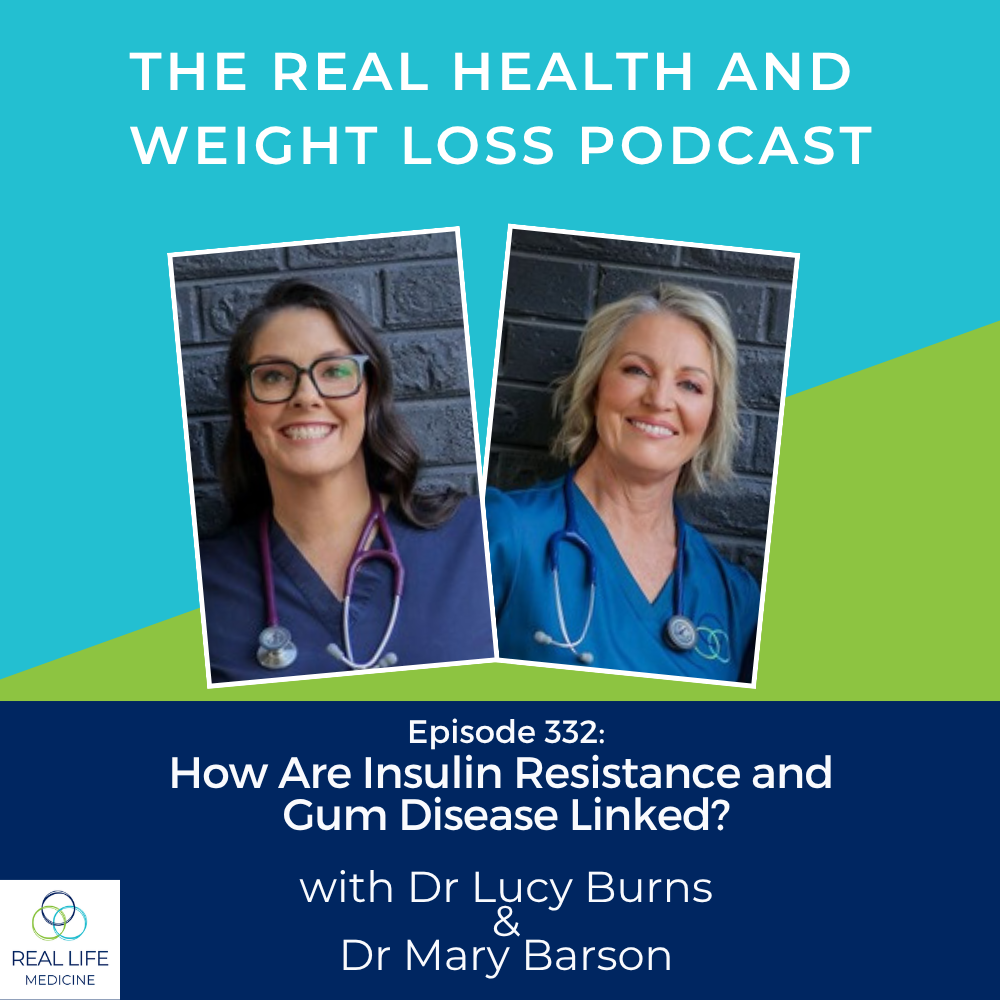
Episode 332:
Show Notes
This episode explores the two-way link between insulin resistance and gum disease, and why your mouth is very much part of your metabolic health. Dr Lucy and Dr Mary explain gingivitis, periodontitis and the oral biofilm, look at research linking insulin resistance with gum inflammation, then share simple, shame-free ways to look after your teeth and gums.
Episode summary
This episode was inspired by a question from a My Metabolic Action Plan coaching call: could you explain the link between insulin resistance and gum disease? Neither doctor is a dentist, and nothing here replaces your dentist's advice. But as Dr Mary points out, the mouth is part of the body, even though our health system tends to treat teeth as something separate.
Dr Lucy starts with the basics. Gingivitis is inflammation of the gums, often related to plaque, and can usually be improved with better brushing and plaque control. Periodontitis is more serious. The inflammation damages the tissues and bone that support the teeth, leading to deeper pockets around the teeth, gum recession and, eventually, loose or lost teeth. The focus is healthy teeth and gums, not perfectly white or straight ones. The mouth is also part of the gut and has its own microbiome, including the biofilm, a thin layer of bacteria that clings to the teeth like slippery algae on a rock.
Dr Mary explains that insulin resistance and type 2 diabetes are related but not the same. With insulin resistance, blood sugar can still be normal while the body works harder and harder to keep it there. Type 2 diabetes is the progression of that process. Insulin resistance also creates a pro-inflammatory state throughout the body.
Type 2 diabetes and periodontitis have an established two-way relationship, and people with insulin resistance are more prone to gum inflammation, even without diabetes. Dr Mary shares a 2018 study of 870 adults without diabetes, which found that those with the highest insulin resistance went on to have more gum inflammation over three years. Whether gum inflammation also helps drive insulin resistance is less certain, but there is a biologically plausible explanation: inflamed gums release inflammatory signalling molecules that circulate through the body and interfere with insulin signalling inside our cells. Dr Lucy compares this with visceral fat, which sends out its own inflammatory messengers.
High blood sugar adds another layer. It increases advanced glycation end products, essentially caramelising proteins and tissues, and is linked to inflammation, oxidative stress and microbiome disruption in the mouth. As Dr Lucy puts it, oral health is an inside job.
The doctors finish with real-life habits. Dr Mary uses an elastic band on her toothbrush as a flossing reminder, and Dr Lucy has discovered that waiting for her HRT gel to dry is the perfect time to brush for the full two minutes and floss.
Key points
- The mouth is part of the body, and gum health and metabolic health appear to influence each other.
- Gingivitis is inflammation of the gums, often related to plaque. It can usually be improved with better brushing and plaque control.
- Periodontitis is more serious. Inflammation damages the tissues and bone supporting the teeth, which can lead to deeper pockets, gum recession and, eventually, loose or lost teeth.
- Some people build up tartar faster than others and may need a professional clean more often than every six months.
- The biofilm is a layer of bacteria that sticks to the teeth. Brushing and flossing work by mechanically disrupting it.
- Insulin resistance is when the body's cells don't respond well to insulin. Blood sugar may stay normal while the body works harder to keep it there. Type 2 diabetes is a progression of this process.
- Insulin resistance creates a pro-inflammatory state throughout the body.
- Type 2 diabetes and periodontitis have a two-way relationship. Each can make the other worse.
- A 2018 study followed 870 adults with overweight or obesity and no diabetes for three years. Those in the highest third for insulin resistance had 19% more bleeding gum sites and 39% more teeth with both bleeding and periodontal pockets at follow-up, after adjusting for factors including waist circumference, smoking and plaque.
- Inflamed gums release inflammatory signalling molecules such as TNF-alpha, IL-6 and IL-1, which can interfere with insulin signalling. Whether gum inflammation drives insulin resistance is still less certain.
- High blood sugar increases advanced glycation end products (AGEs), essentially caramelising proteins and tissues, and is linked to inflammation and microbiome disruption in the mouth.
- Sugar feeds the bacteria that cause tooth decay. Putting babies and toddlers to bed with a bottle of juice or milk lets sugars pool in the mouth overnight.
- Inflammation is a key driver of chronic disease, and inflamed gums are associated with worse health outcomes more generally.
- Make good habits easy: a reminder on your toothbrush, flossing picks, or pairing flossing with something you already do every night.
- Not all self-care is fun. Dental check-ups and professional cleans count, along with mammograms and cervical screening.
Practical takeaway
Looking after your gums isn't only about brushing and flossing. It's also an inside job. The same foundations that support your metabolic health, such as real food, fewer sugary snacks, good sleep and less stress, support healthy gums too.
The outside job still matters. Brush for the full two minutes, find a flossing method you'll actually use, and keep up regular dental visits. It's one of the easiest, cheapest health habits there is.
Work With Real Life Medicine
For a step-by-step approach to improving metabolic health in perimenopause, menopause and beyond, check out My Metabolic Action Plan. This doctor-led comprehensive program gives you
Strategies to improve metabolism
Skills to develop mindset
Tools so you will implement!
Episode 332:
Transcript
Dr Mary Barson Hello lovely friend, I am Dr Mary Barson.
Dr Lucy Burns And I'm Dr Lucy Burns.
Both We are doctors, weight management and metabolic health experts. We are the creators of My Metabolic Action Plan, your two-step map to real health and weight loss, which is in fact the name of this podcast. Join MyMap now at rlmedicine.com.
Dr Mary Barson (00:05) Hello, lovely friend. Dr Mary here for another episode of the Real Health and Weight Loss Podcast, joined on this springy day by my beautiful colleague, Dr Lucy. Hey, Lucy.
Dr Lucy Burns (00:17) Hey Dolly, how are you?
Dr Mary Barson (00:19) I am good. School holidays are over, and that is both a good and a bad thing. I have survived them, and now it's back into work.
Dr Lucy Burns (00:27) Yes, indeed. Routines can be sometimes helpful and sometimes burdensome. They say a change is as good as a holiday, but I don't know about that. I quite like a holiday, really.
Dr Mary Barson (00:41) That's right. Well, holidays with kids aren't really a holiday, but it's okay. It's just the season that I'm in right now.
Dr Lucy Burns (00:50) Indeed. And I'm way past that season, as most of you will know. My kids, my kidults, are now adults, and they're proper adults. They're well into their twenties. So it's a long time since then. Well, you'll be looking at that for a little while.
Dr Mary Barson (01:01) I look forward to that. About twenty years, really, and then my kids will be well into their twenties.
Dr Lucy Burns (01:15) Yes, that's somewhat sobering. So, as part of child rearing, you will have had to teach your children, as I did, to brush their teeth.
Dr Mary Barson (01:29) It's a nightly battle, but one that I will keep fighting because it's important.
Dr Lucy Burns (01:33) It is. And we thought this week we would have a chat about teeth and gums and insulin resistance, because most of you know that when we're talking about metabolic health, we're talking about the food, the sustenance, the sleep, the stress, the movement, the sunshine, social connection. And we talk about the diseases that we're trying to prevent, Alzheimer's and all of that sort of jazz. And most of us don't give a toss about our pearly whites necessarily. So we thought we might have a little chat about it.
Dr Mary Barson (02:10) Yes, I think it's good, because the mouth is part of the body. It is a bit weird that in Australia and other countries of the world we separate teeth and dentistry. I've spoken to European doctors who were just like, "What kind of idiot system do you have here, where you think the teeth are separate from the rest of the body?" And I'm like, yes, that's true, but I'm not a dentist. Lucy, you're not a dentist, and yet we do still care about our teeth. And insulin resistance has a really integral part to play in the health of our gums. And interestingly, the health of our gums also seems to play a role in our metabolic health as well. It's a bidirectional thing, which I think is extremely interesting.
Dr Lucy Burns (02:59) Absolutely. A, I love bidirectional things, but B, I was totally fascinated by this. And C, the inspiration for this podcast actually came from one of our coaching call questions in My Metabolic Action Plan, where somebody said to me, "Could you explain the link between insulin resistance and gum disease?" And I'm thinking, huh? Well, actually, not yet. I'll have to go and look it up. So here we are, looking it up.
Dr Mary Barson (03:23) I love it.
Dr Lucy Burns (03:25) And it always astounds me. When you think you know everything about something, you realise there's always more to learn.
Dr Mary Barson (03:33) I do, and I think that's beautiful. If we knew everything, life would be very boring indeed.
Dr Lucy Burns (03:40) Exactly. And as you know, we are both lifelong learners, sometimes learning things that seem irrelevant. At the moment, I'm obsessed with learning chess and crochet.
Dr Mary Barson (03:50) You should play chess with my daughter. She loves that. I look forward to the days when I have kids in their twenties and I can learn to crochet. Maybe you can teach me, Lucy.
Dr Lucy Burns (04:02) Absolutely. Although by the time that happens, that's a long time away. Twenty years.
Dr Mary Barson (04:08) It is a long time, but I'm optimistic. I reckon you've got a beautiful brain, and you take care of yourself. Let's see.
Dr Lucy Burns (04:14) True. Let's see. So let's chat about gums, teeth, all of the things, and explain the connection between insulin resistance, gum disease and dental health.
Dr Mary Barson (04:29) Absolutely. And I think dental health is one thing that we can sometimes feel a bit guilty about, because caring for our teeth can be just another chore. Going to the dentist can certainly be another chore. Perhaps some of us have gums that bleed regularly when we brush our teeth, and we might not want to be doing anything about it. So this is definitely not about shame and guilt. This is really just about information, and an opportunity to understand your health better and identify the links between your metabolism and your gums, and your gums and your metabolism, and what we can do. So, Lucy, maybe we should start with the basics. Perhaps talk about gums, gum disease, and what we mean when we talk about gum inflammation. Before we talk about the link, maybe we should actually talk about what it is.
Dr Lucy Burns (05:18) Yes, absolutely. It's interesting. Some people will get bleeding gums and some people don't, but there are a couple of things that are important. There's a thing called gingivitis, which is inflammation in the gums. You all know what gums are. It's inflammation that's often related to plaque on our teeth, so we can usually fix that if we brush our teeth a bit better or control the plaque. And this is just a side note. I love putting in side notes. There's obviously something in saliva that determines how people build up tartar, particularly on the back of the bottom teeth. And unfortunately, I am the best tartar producer of all time. There are so many other things I wish I could produce, but no, it's tartar. Which means I have to get my teeth professionally cleaned regularly. It should be done every six months, and I probably need to get mine done every three months, which is really annoying. But again, it's just part of plaque control. So we've got gingivitis, and then there's something called periodontitis, which is a little more serious. That's when the inflammation can damage the tissues and the bone that support the teeth. We can get deeper pockets around the teeth, and people can get gum recession. You may have heard of that. And eventually people can even get loose teeth or lose their teeth.
Dr Mary Barson (07:09) Yes, because of what's happening in the gum.
Dr Lucy Burns (07:13) Yes. And this is all separate to bog standard dental decay, which most of us know about.
Dr Mary Barson (07:20) Yes. And we're talking about the health of your teeth and gums here, not them being perfectly white and straight and cosmetically gorgeous. We're just talking about the health of the structures.
Dr Lucy Burns (07:30) Yes, we want your teeth to be HOTI.
Dr Mary Barson (07:30) Well, yes, we want your teeth to be healthy on the inside. We don't mind if they're naturally a bit brown or beige or whatever they are, and we certainly don't care if they're crooked. It's about them being healthy and making sure the structures that hold them in place are healthy, because it can suck. Some of these conditions can be pretty painful and really reduce quality of life, not to mention the expensive dentist bills.
Dr Lucy Burns (07:58) And when we talk about crooked, we're talking about small deviations in alignment. There are obviously bigger things that can affect the way your mouth closes and the alignment of your top and bottom molars and all of that sort of stuff, which is way outside my scope, that are helpful to correct for the ongoing longevity of your teeth. But there's a cosmetic dental industry, and there's a health of your teeth, gums and mouth industry.
Dr Mary Barson (08:38) Yes, and we're more interested in the latter. And I do need to say, if we haven't already, just a disclaimer: we're not dentists. So anything we say here does not replace the advice of your dentist.
Dr Lucy Burns (08:50) Yes, absolutely. And I think one of the most interesting things to talk about is that the mouth is actually part of the gut. There's a microbiome within your mouth. And there's a thing called the biofilm, which is like a little layer of bacteria that sticks onto your teeth. I think of it a bit like that soft seaweed on a rock, that sort of algae, seaweedy stuff, whatever that's called.
Dr Mary Barson (09:22) Yes, it makes it slippery.
Dr Lucy Burns (09:25) Yes, that. That's like your biofilm. And that is associated with plaque and decay as well.
Dr Mary Barson (09:33) Yes. And that's what you need to scrub off twice a day. Not so hard that you scrub away your gums as well, but the mechanical removal of that biofilm is what helps reduce plaque and tartar formation and reduce gingivitis and periodontitis, which are two things that we really don't want.
Dr Lucy Burns (09:53) Yes. So we've been banging on a bit about big terms and some conditions, but what has all of this got to do with metabolic health?
Dr Mary Barson (10:03) So there's a fascinating link between insulin resistance and gum disease. And I think it's always useful to very quickly go back to basics. When we talk about insulin resistance, people will also think about type 2 diabetes. And although they're related, they're not exactly the same. Insulin resistance is when the cells and tissues of the body don't respond effectively to insulin. The pancreas can make more and more insulin, but the cells and tissues aren't responding as well. People who have insulin resistance can still have normal blood sugar, but their body is having to work harder and harder to keep the blood sugar normal. Type 2 diabetes is when that process of insulin resistance has been going on and slowly getting worse for years, to the point where the body is no longer able to keep the blood sugar under control. So type 2 diabetes is a progression of insulin resistance. And in type 2 diabetes, people have got high insulin levels and all the problems that go along with that, as well as dysregulated blood sugar and all the problems that go along with that. And insulin resistance isn't just about insulin and it's not just about sugar. It also creates a pro-inflammatory state, which causes problems throughout our body. It also drives metabolic disease and high blood pressure, which is also relevant to this discussion and to the health of our gums.
Dr Lucy Burns (11:25) Right. Good. We've got so much to talk about. So tell me, what's going on? Tell me about some research.
Dr Mary Barson (11:36) Yes. This is fascinating. There's an established bidirectional relationship, and the research is in type 2 diabetes, so we'll talk about that first. Between type 2 diabetes and periodontitis, we've got evidence that periodontitis can make diabetes worse and diabetes can make periodontitis worse. But also, with insulin resistance, so we're talking normal blood sugars here, even without diabetes, people with insulin resistance are more prone to get gum inflammation. And it also seems that gum inflammation is an independent risk factor that can contribute to insulin resistance. That last bit is a bit less certain. We know that insulin resistance can help drive gum inflammation, but there is perhaps some research that it can go the other way, that the gum inflammation somehow drives insulin resistance. That might be driven through our gut microbiome. We don't really know, but it is extremely interesting.
Dr Lucy Burns (12:33) Goodness. So what did they find?
Dr Mary Barson (12:38) There was a study published in 2018, the one that we found, which was pretty good. I like this study because it had quite a lot of people. They looked at 870 adults who were either overweight or obese and who didn't have diabetes at the beginning of the study. They followed them for three years and estimated their insulin resistance using HOMA-IR, which is an easy way to estimate people's level of insulin resistance. And they found that the third of people with the highest insulin resistance had significantly more gum disease, gingivitis, than the people who didn't: 19% more. And this was statistically significant. They controlled for other risk factors, and they found that insulin resistance was related to more gum disease when they controlled for confounding factors. They also found they had 39% more teeth with both bleeding and periodontal pockets, so they had worse gum disease as well. It's really interesting. They adjusted this for waist circumference, smoking, plaque levels and gum inflammation at the start. So, quite robust findings that insulin resistance drives gum disease.
Dr Lucy Burns (15:04) So, Mary, what you're saying is that in this research, they found that people who had more significant insulin resistance had more gum and teeth disease. Is there a study, and I'm sure there is because you wouldn't make the claim without one, that has a mechanism and outcomes on how inflammation of the gums can affect metabolic health?
Dr Mary Barson (15:37) Yes. This is coming into some of the bigger claims that this study does support, and there is a proposed connection. The proposed connection is, as you mentioned, inflammation. When the immune system responds to the periodontal bacteria in the mouth, it produces inflammatory signalling molecules, as we always do with inflammation. The good old signalling molecules, such as TNF-alpha, that's tumour necrosis factor alpha, and interleukins, IL-6 and IL-1. These are pro-inflammatory signalling molecules, and they create flow-on effects throughout the body. We think that periodontitis is also associated with higher levels of inflammation and inflammatory markers in the circulation, and that the inflammation isn't necessarily just confined to the gums. It creates inflammation throughout the whole body. So bleeding gums aren't just a problem in your mouth. Bleeding gums can be a problem for your whole body. And we know that these pro-inflammatory signalling pathways do interfere with our insulin signalling pathways inside our cells. So there's this biologically plausible explanation for what's seen in this study, about how periodontal inflammation can add to inflammation more generally, which can then exacerbate or potentially help drive insulin resistance and problems with insulin signalling right down at the level of the cells.
Dr Lucy Burns (17:11) I just think the whole thing's so fascinating. The concept of bacteria, microbiomes, inflammation, insulin. It's like a little triad, isn't it? We know that inflammation is a big problem with visceral fat deposition, and we know that the pathways there are disrupted, and that visceral fat sends out adipokines, which again is a fancy name for inflammatory markers. And it seems like little pockets of gum disease do the same thing.
Dr Mary Barson (17:49) Yes. It's an overall contributor to inflammation in the body. And inflammation is one of the key drivers of all of the chronic illnesses that we would like to manage and avoid, like dementia, cancer, heart disease and strokes. Inflammation plays a key role. And I don't want to be drawing too long a bow here. I'm not going to say gum disease equals breast cancer. I am not saying that. But what the science does support is that inflamed gums equal worse health outcomes more generally, and it's probably because of this increased inflammation. Doing what we can to manage all inflammation in our body is helpful.
Dr Lucy Burns (18:38) Yes. And I think the other interesting thing, and we've all known this growing up, is that sugar causes tooth decay. That's not an unreasonable thing to know. There are actually multiple mechanisms, and bacteria are part of that mechanism. There's a particular species of bacteria that loves sugar and lives in the mouth, and so you get an overgrowth of that. Tooth decay, yada yada. But there's also the concept of advanced glycation end products, which we see in many aspects of health, in inflammatory things in arthritis and joints. And they also seem to be prevalent in the mouth as well.
Dr Mary Barson (19:29) That's right. High blood glucose increases those advanced glycation end products, or AGEs. So essentially, how sugary your blood is contributes to how caramelised your proteins, cells and tissues get. Caramelisation is pretty much the same process. And in case you're wondering, that is not a good thing.
Dr Lucy Burns (19:47) No.
Dr Mary Barson (19:57) Caramel may be tasty when you burn the sugar on a crème brûlée, but it's definitely not what you want happening inside your cells and proteins. So there's this overlapping mechanism. When we've got high blood sugar, it can increase the inflammation inside our mouths, and it also seems to disrupt the microbiome. So we're getting increased inflammation, and we're getting an unhealthy microbiome. Quite aside from what the sugar is doing locally in the mouth, high blood sugar is also driving inflammatory changes within the mouth, and probably also driving gut dysbiosis and mouth dysbiosis, which all together creates this tissue-damaging inflammation.
Dr Lucy Burns (20:47) Absolutely. So from what I'm understanding, oral health is not just about brushing your teeth and flossing, which is helpful to disrupt that biofilm we were talking about. It's also an inside job, like everything. The teeth and the gums have little blood vessels that come from the inside to supply them, and the quality of the blood going through those little microvessels matters.
Dr Mary Barson (21:21) It does. We know that high blood sugar can really damage our blood vessels, as can increased oxidative stress, and those two things can interact with each other. Both of these things damage our cells and our proteins, can overwhelm our body's healing processes and our detoxing processes, and are just really, really bad for us. So it does put brushing our teeth and avoiding those sugary snacks into sharper focus when you look at it through this lens.
Dr Lucy Burns (21:57) Yes, absolutely. Many of you listeners will be past the age where you've got small babies and children, but there was a time when toddlers used to be put to bed with a bottle of juice. And they found that they all developed tooth decay before the age of four. So that practice has been discouraged. And in fact, the same with a bottle of milk, because milk has lactose in it. Lactose is glucose and galactose, and galactose breaks down to glucose. It's not the same as sugar, which has fructose in it, but it is glucose, which is what we often call sugar. So it matters, doesn't it?
Dr Mary Barson (22:51) It does. And just to clarify that point, it's not that babies and toddlers shouldn't be having the milk. It's that they shouldn't be having the bottle in bed, because the milk pools in their mouth overnight, and that can be devastating to their oral health. Have the milk, brush their teeth, go to bed. That's fine. But don't use the bottle overnight, like a dummy.
Dr Lucy Burns (23:16) Like a dummy. Yes, absolutely. All right, so let's bring this back to everyday chit-chat. What should people be doing?
Dr Mary Barson (23:30) You really should pay attention to your teeth. I think that's really important. We're not telling anybody what they don't already know, but brushing your teeth regularly is helpful, seeing the dentist regularly is helpful, and taking care of your teeth. And it can be hard to do this. So, like any kind of lifestyle change or lifestyle intervention, you need to think about ways you can make it easy and make it work for you. Although I think mostly, not universally, teeth brushing is a habit that people have wired into their lives, because as a society we've really pushed it.
Dr Lucy Burns (24:14) And they've got mothers like you who are battling their kids every night to brush their teeth. That sends a message that this is important. Even if they rebel at the time, they catch up later.
Dr Mary Barson (24:22) That's it, every day. I do struggle with flossing. I'm going to out myself here. I didn't grow up with flossing as a message. I think I should have, I just didn't. And I can forget to floss my teeth, so that's one I'm working on. My latest way to make it easier is I've put a little elastic band on my toothbrush, right where my hand would go, and that little elastic band is just a reminder: floss. Because I'm happy to floss, I just forget. And I've got a little box of flossing toothpicks, which I find really quite easy to use. So that helps me. The elastic band: floss. And that has worked for me. With my children, I've just done everything I can to make it appealing. I bribe my teenager, and I've got little animal floss sticks for my four-year-old. So that's how we're working on that habit.
Dr Lucy Burns (25:19) Well, it's interesting, mine is different. I don't forget to floss, I just hate doing it. It's not even that it's hard, it's just boring. So the revelation for me has actually been HRT, because I put the gel on at night and it takes about three or four minutes to dry. So now I do the full two minutes with the toothbrush, when I was probably a 30-second brusher. "That'll do." Now I do the full two minutes, because what else are you going to do while you're sitting waiting for it to dry? Then I think, well, I've still got a minute, so I get out my floss stick thingy and do that. And while I'm there, I'm also imagining the breaking of the biofilm, because I like to visualise what I'm doing with my body. I heard about the biofilm a few years ago, and it's not about getting rid of bits of meat between your teeth necessarily, although that is good. It's about disrupting this biofilm, particularly between your teeth and down those little side bits. And to be honest, I had a mouthful of fillings growing up, because I had a lot of sugar and I probably didn't brush my teeth very well. And I haven't had a filling now for a long, long time, a decade or more. But I still have to go and get the tartar fixed. I've just put that into my self-care routine. It's not self-care like a bubble bath, but it's self-care because I'm looking after my fangs.
Dr Mary Barson (27:02) That's right. Not all self-care is fun. Mammograms, dentists, cervical screening. That is self-care. It's not soothing, but it still needs to be done.
Dr Lucy Burns (27:14) Absolutely. All right, lovely ones. Have fun brushing your fangs, and look after your dental health. Know that everything you're doing there is good for your gums, but it's not just your gums. There's a possible link to preventing chronic disease down the path, diabetes, Alzheimer's, all of that, just by polishing your pearls.
Dr Mary Barson (27:36) Yes. It's one of those nice, easy interventions where you're genuinely doing something helpful.
Dr Lucy Burns (27:42) I know, and it's free. So there we go. All right, lovely ones. Talk soon.
Dr Mary Barson (27:44) Bye.
Dr Lucy Burns The information shared on the Real Health and Weight Loss Podcast, including show notes and links, provides general information only. It is not a substitute, nor is it intended to provide individualised medical advice, diagnosis or treatment, nor can it be construed as such. Please consult your doctor for any medical concerns.