HOW DOES NIGHT SHIFT AFFECT YOUR HEALTH? (AND WHAT YOU CAN DO ABOUT IT)
One of Australia's Most Popular Podcasts with Hundreds of 5 Star Reviews

Grab your FREE Ebook copy now!
Have you struggled to lose weight and keep it off?
Start your journey to boost metabolism and transform your body into a fat-burning powerhouse.
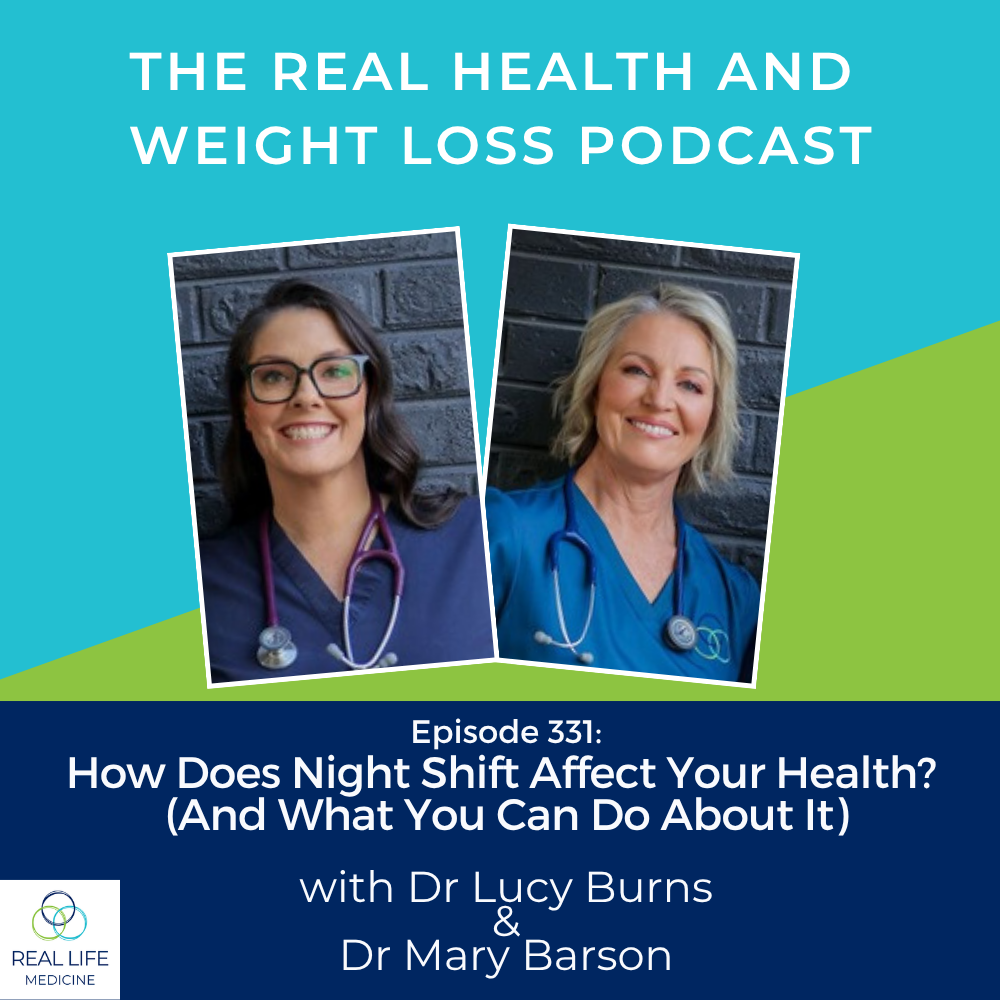
Episode 331:
Show Notes
This episode explores how night shift affects your health, from circadian disruption and sleep debt to insulin resistance, clock genes and cellular ageing. Dr Lucy and Dr Mary explain why these effects aren’t about willpower, then share practical ways shift workers can protect their metabolic health by focusing on what’s within their control.
Episode summary
Both doctors worked regular night shifts as junior doctors and registrars, and Dr Mary still shares the on-call roster as a rural GP. They know firsthand how disruptive night work can be, and how much society relies on the people who work while the rest of us sleep, from hospital staff and firefighters to police and call centre workers.
The central problem is misalignment. On night shift, sleeping, eating, light exposure and activity all happen out of step with the body’s circadian rhythm. Night shift also creates a sleep debt that’s hard to avoid, even when people manage to sleep during the day. Together, these increase insulin resistance and affect how the body regulates glucose, and which genes are switched on and when.
Dr Mary explains the body’s timekeeping system. The suprachiasmatic nucleus, a small part of the brain sitting just above where the optic nerves cross, responds to light and coordinates clocks in the liver, pancreas, muscle and even inside individual cells. Bright light at night sends conflicting signals, so different organs adjust at different rates. Rather than a well-conducted symphony, the body ends up sounding more like an orchestra tuning up.
The doctors discuss clock genes such as CLOCK and BMAL1, and why both eating and being awake during the biological night produce a less favourable glucose response. These mechanisms help explain the increased risk of type 2 diabetes associated with shift work. Shift work is also associated with epigenetic changes and telomere shortening, both linked to cellular ageing, and we become less resilient to these effects as we get older.
Importantly, these effects happen independently of lifestyle choices or willpower. Dr Mary also finds it heartening that most of the research looks at shift workers eating a standard diet with plenty of processed food, people who haven’t yet done everything they can to optimise their health.
The second half of the episode turns to what shift workers can control: food, meal timing, hydration, caffeine, daytime sleep, naps, exercise and stress. Dr Lucy shares the sleep sessions that made her own night shifts manageable, and both doctors reflect on the junk food picnics and ice cream raids of their training years.
Key points
- Night shift disrupts health mainly through circadian misalignment. Sleep, meals, light and activity all happen out of step with the body’s natural rhythm.
- Sleep debt is hard to avoid on night shift, and it increases insulin resistance.
- The suprachiasmatic nucleus in the brain responds to light and coordinates body clocks in the liver, pancreas, muscle and cells.
- Bright light at night sends conflicting timing signals, so different organs fall out of sync with each other.
- We naturally become more insulin resistant at night. Eating during the biological night produces a less favourable glucose response, and so does simply being awake then.
- These mechanisms help explain the increased risk of type 2 diabetes associated with shift work.
- Shift work is associated with epigenetic changes and telomere shortening, both linked to cellular ageing.
- We become less resilient to the effects of night shift as we age, and some workplaces offer exemptions for older night shift workers.
- The health effects of night shift are not a reflection of willpower or lifestyle choices.
- Pack protein-rich food rather than relying on junk food to get through the night, and stay well hydrated.
- Keep meal timing as close to your usual pattern as you can. A smaller meal overnight is usually enough.
- Keep caffeine to earlier in the shift. Even if you can fall asleep after coffee, it still affects sleep quality.
- Protect your recovery. Treat daytime sleep as essential, not a nice extra, and avoid filling the day with errands.
- Make your room dark and cool, use earplugs or an eye mask if they help, avoid scrolling before bed, and use naps when you need them.
- Gentle exercise before bed after a night shift can increase sleep pressure, but exercise shouldn’t compete with essential sleep.
- Reduce other stressors where you can, including optional commitments that can wait until life is less hectic.
Practical takeaway
Society needs shift workers, and many people need the work. The goal isn’t to stop night shift or to get everything perfect. It’s to prioritise the things within your control and double down on them as much as you can, without becoming obsessed.
Use the six S’s as your guide. Choose good quality food and time it as best you can, protect your sleep, keep moving in a way that supports recovery, and let go of stress you don’t need to carry.
Work With Real Life Medicine
For a step-by-step approach to improving metabolic health in perimenopause, menopause and beyond, check out My Metabolic Action Plan. This doctor-led comprehensive program gives you
Strategies to improve metabolism
Skills to develop mindset
Tools so you will implement!
Episode 331:
Transcript
Dr Mary Barson Hello lovely friend, I am Dr Mary Barson.
Dr Lucy Burns And I'm Dr Lucy Burns.
Both We are doctors, weight management and metabolic health experts. We are the creators of My Metabolic Action Plan, your two-step map to real health and weight loss, which is in fact the name of this podcast. Join MyMap now at rlmedicine.com.
Dr Lucy Burns (00:12) Morning, lovely friend. Dr Lucy here on a spectacular Tuesday morning with my beautiful colleague Dr Mary. How are you this morning, Mary?
Dr Mary Barson (00:20) I am slightly chilly, but looking out at the sky, which is possibly going to be sunny, so I'm feeling pretty good about that.
Dr Lucy Burns (00:31) Yes. So for those of you, and I'm sure most of you know, we're both Victorian based, either side of the bay. And I think one of the tricky things at this time of the year is hay fever. I've never really had much hay fever, but this year, wowee. I feel like I'm a dripping tap some days. It's intense.
Dr Mary Barson (00:53) It is. I think it's a particularly bad spring for hay fever. And I don't know about you, but in my clinics I'm seeing a bit more asthma exacerbations and other things related to that. So it has been a pretty polleny spring. And Southern Victoria is one of the asthma capitals of the world. There is something about our climate that is particularly polleny and particularly atopic, asthmatic and allergic. So it has its beautiful points living here, but it also has its sneezy and wheezy points as well.
Dr Lucy Burns (01:29) I know. One of the benefits for us is that we've got some paddocks with ryegrass in them, and the ryegrass seeds are what cause a lot of the hay fever and the asthma. But the eastern rosellas love them. So we have flocks of rosellas eating the grass seeds and it's lovely.
Dr Mary Barson (01:48) It is. Slight diversion, but once when I was little, I got some ryegrass, put it in a vase and put it in my room on a shelf over my bed. And I was having the absolute worst asthma and nobody could figure it out. No one could figure it out until one day my older sister came home, she's quite a lot older, and she saw this ryegrass hanging over my pillow. Mary's bathing herself in ryegrass pollen all night, every night. And then we were like, huh. My asthma got better after that.
Dr Lucy Burns (02:21) That's a good bit of root cause analysis there.
Dr Mary Barson (02:23) Yeah.
Dr Lucy Burns (02:25) So, a little segue. Clearly that's an environmental issue. And now moving into other environmental issues that can affect metabolic health. We thought we would have a chit-chat on sleep and night shift workers, how night shift affects health and, more importantly, what we can do to mitigate some of these risks.
Dr Mary Barson (02:49) And I think that last bit's so important, because we can't always control our working environment. You and I, Lucy, we did our time, regular night shifts as medical trainees, junior doctors and registrars. I think you don't have to do that very much anymore, which is great. I do a little bit. As a rural GP, I share the on-call roster. It's not the same as night shift, but there are some nights when I'm called in to work and my sleep gets disrupted. So we know firsthand what night shift feels like. But we also know firsthand how important our night shift workers are, in the hospital, in the fire department, in all of these things that make our society tick. We need these beautiful people who work nights, some of the time or all of the time. And I think it's important to understand what that does to our health and what we can do about it.
Dr Lucy Burns (03:42) Indeed. Indeed. So, Miss, let's dive straight in. What does night shift do to our health? We all know that you get a bit tired and a bit grumpy the next day, and maybe the next few days. But what's going on?
Dr Mary Barson (03:58) One of the main reasons shift work disrupts our health is this central problem of misalignment. When we are sleeping, having our meals, getting exposed to light and being active, all of that occurs out of step with our body's innate biological rhythms, out of step with when ideally we should be doing these things. That's the main thing. We're out of step with our circadian rhythm.
But it also creates sleep deprivation. There's almost no way around that. Even if you are managing to sleep during the day, when you move rotations and go off nights, you do get a sleep debt. And that sleep debt affects our metabolism, increases our insulin resistance and does all kinds of things to our metabolic health.
These things put together have flow-on effects to our metabolism, to the way that we regulate sugar, the way that we regulate insulin, to what genes are expressed and when they're expressed. It can even affect our chromosomal length and the way that we age. I think we could go into more detail on this, and I think that would be helpful. But the main point with shift work is that it forces us out of our natural circadian rhythm, and that circadian disruption is what drives most of the adverse effects on our metabolism.
Dr Lucy Burns (05:31) Yes, absolutely. So humans are what is called diurnal creatures, which means we are awake in the day and asleep at night, as opposed to possums, who are nocturnal. And this is a little side note, another little anecdote. The other day, my hubby was driving down our driveway and he thought he saw a kangaroo in our garden, or a little wallaby. It turned out to be a possum. A ringtail possum, no, a brushtail possum. A big boy brushtail possum with a big long tail, at about four o'clock in the afternoon, chowing down on the roses, having a great old time.
Dr Mary Barson (06:02) Cute. Doing the day shift. They're normally asleep.
Dr Lucy Burns (06:13) So his circadian rhythm was all out of whack as well. He's on the night shift, on the day shift.
Dr Mary Barson (06:19) That's right. What if that possum's metabolism was suffering, because he's eating those rosebuds in the middle of the day?
Dr Lucy Burns (06:25) Correct. So as humans, we are governed by circadian rhythm, which is essentially the 24-hour clock: asleep in the dark, aka night-time, and awake in the sunlight, aka daytime.
Dr Mary Barson (06:42) Absolutely. And I think it's important to know that these effects happen independently. The bad effects of shift work happen independently of other things. So if people's health is suffering because of night shift, it's not related to their lifestyle choices or their willpower. It really is the fact that we are not designed to be awake at night and then trying to sleep during the day, and all these flow-on effects can be quite deleterious.
However, we definitely want to stress that it's not all doom and gloom, and there are a lot of things we can do. But I reckon it'd be helpful to dive into this a little bit more. Body clocks are a fascinating subject. I find it amazing how important circadian rhythms are to our health and how they control absolutely everything. When our body clocks are well aligned, when they're well coordinated with night and day, everything can work better. And conversely, when they're not, everything can suffer.
Our brain clock responds primarily to light. We've got this really cool little bit of our brain called the suprachiasmatic nucleus that sits at the front, in the centre, behind our forehead. It's right where the optic nerves from our eyes cross over, like a little X. And right above there, just where both optic nerves meet, is the suprachiasmatic nucleus, and it's there tasting the light that hits our eyeballs and comes through our optic nerves. This is the main timekeeper. It then has flow-on effects to all of the other body clocks throughout our body.
Most of our organ systems have their own body clocks that all coordinate with the suprachiasmatic nucleus. It talks to other parts of our brain, including the parts that make hormones. It's quite complicated. But we've got little clocks inside our liver, clocks in our pancreas and little clocks inside our muscle that help regulate those local metabolic processes. And we've also got genes that are turned on and off that are really important.
This system works well when everything is in sync, when we are getting that morning sunlight and our circadian rhythms get reset. Everything is happy. It's like the conductor that makes it all work really well. But night shift then provides conflicting timing signals. We're getting bright fluorescent light in our eyeballs at night-time because we have to. We're in the hospital and we need to see what we're doing if we're putting in an IV drip. That means different organs may adjust at different rates, and it can reduce coordination throughout the body. So you get this circadian discordance throughout the body. Rather than a beautiful, well-conducted symphony, it sounds more like the mess of the orchestra when it's tuning up before it starts.
Dr Lucy Burns (09:58) Yeah, that's a good analogy. And it is interesting, because quite often we do things at night, apart from being awake when we're ideally meant to be asleep, that we're not meant to be doing at night. As you mentioned, particularly for healthcare workers but other workers too, stress at night, reactivity at night. We're not really supposed to be doing that. All of those stress responses should ideally be nice and calm while we're sleeping at night, but not if we've got stressful jobs. Whether it's healthcare workers, law enforcement, or even call centres that operate overnight, they're dealing with stressed, angry people and having to mitigate all of that.
But I reckon one of the trickiest things I've seen, and I absolutely know still goes on, is that people eat overnight, often to keep themselves awake. And they will often eat junk food because it's a little "treat" to mitigate this terrible, horrible night shift that you're doing. So we will jolly it all along by having a picnic.
Dr Mary Barson (11:13) Absolutely, I used to do that. I remember doing night shift as a gynae resident, and the special care, the paediatric, resident and I hung out a lot, as you might imagine, with the mums that had just had their babies. We knew where to find all of the Dixie cup ice creams in the hospital, the ones that weren't very well guarded. They were meant for the patients. So I'm admitting to being a petty criminal here.
Dr Lucy Burns (11:39) A stealer.
Dr Mary Barson (11:40) That's right. We'd go and find those little bits of ice cream, eat them and feel that this was such a fabulous idea, because it was keeping us awake. We'd get a nice little sugar hit and that would set us up for the next emergency caesarean, which was never that far away.
Dr Lucy Burns (12:00) Indeed, indeed. So you mentioned the clock genes. Can you tell us a bit more about those?
Dr Mary Barson (12:12) Yes. We have these fabulous little genetic clocks, the clock genes, that are epigenetically turned on and off in response to our light signals and circadian rhythms. And they've got beautiful names. One of them's actually called CLOCK. I think that's a really good name. BMAL1 is another. It's not quite so good. These genes are turned on and off, and they help coordinate our daily patterns of cellular activity.
I talked about our different organ systems having their own little clocks, but our cells do as well. Even our intracellular organelles, the little structures within our cells, have their own little clocks. We are very much a clock-driven species, and our entire metabolism is dictated by, and flows with, the ebb and flow of day, night, day, night.
When this is disrupted, our health can suffer in multiple ways. I think one of the easiest to grasp, and one of the more significant, is that we become more insulin resistant. The flip side of that is that our insulin sensitivity deteriorates. Sleep restriction and circadian misalignment reduce our cells' ability to respond effectively to insulin, and they also reduce our glucose tolerance.
This happens normally, too. We naturally become more insulin resistant at night-time. It's why it's not a great idea to stack all your food at night or eat late at night. But if you're sleeping during the day on shift work and that's your only chance to eat, then that's probably going to be happening.
Insulin secretion and insulin effectiveness are dictated by our circadian rhythms, but also by the flow and synchronicity of all of those circadian rhythms. So eating during the biological night produces a less favourable glucose response, but just being awake during the biological night also creates a less favourable glucose response. These are the mechanisms that help explain the increased risk of type 2 diabetes associated with shift work, and it's something we need to be aware of.
I know I said this is going to be infused with hope, and we are being a bit doom and gloom at the moment. But I think it's important to discuss the doom and gloom first, so you can understand how important it is. The stakes are very high. If I was to go back and be a gynae resident or the paeds resident doing emergency caesareans overnight, I probably wouldn't be snacking on all the Dixie cups like I did in my twenties. I would probably not do that now.
Dr Lucy Burns (15:24) No. And like lots of human processes, you are a little more resilient in youth, so you can get away with it. As we get older, we are less resilient, just biologically. In fact, some places have exemptions for night shift workers over a certain age, because the health effects are so great for them. So it's worth noticing those things as well.
There are lots of complicated things, as you've mentioned, related to insulin and insulin signalling. And it's way out of my scope of practice, but there are other pathways. There's one called the Akt pathway, spelled with a K, which I like because I'm always doing ACT, as in acceptance and commitment. The Akt pathway is a cellular pathway that is really involved in cell preservation, cell survival and cell destruction. It has multiple components, with vascular formation and, again, glucose signalling. And all of that is completely disrupted by sleep deprivation.
It's like lots of things we say. One night of sleep deprivation isn't going to kill you, but years and years of it are going to impact your health, sometimes catastrophically. What that means is that if you are a shift worker, there are things you need to double down on to try and mitigate the effects as much as you can.
Dr Mary Barson (17:10) Yes, it's really important. The other really fascinating thing is the epigenetic changes I mentioned. Epigenetics is the science of gene regulation. It changes what your genes do without changing the DNA sequence. This is really important, because you could have the best genes in the world, but if they're not turned on, and turned on at the right time, that mitigates those benefits. Likewise, you might not have great genetics in certain areas, but if you can modify that epigenetically, turning the right things on at the right time and the wrong things off, then you could be protected.
We do know that shift work can create epigenetic changes that aren't helpful for our health and longevity, and it can be associated with accelerated ageing. Shift work is also associated with telomere shortening.
Telomeres are a really cool little concept. They are caps of DNA that sit at the ends of our chromosomes. DNA is two twisted strands of deoxyribonucleic acid stuck together. They can pull apart and unravel. If you've ever seen it, it's quite stringy. If you do experiments where you extract DNA, it's a bit like slime. Our DNA is neatly packaged up into chromosomes in the nucleus of the cell. And to stop it from unravelling at the ends, we have these little caps on it. They act very much like the little caps at the ends of shoelaces. You know when you lose those caps and your shoelaces start to fray? That's what telomeres do. They stop our DNA from fraying.
Our telomeres naturally shorten as we get older, because every time our cells replicate, we can't quite copy to the very end of the chromosome. It's a little deficit in our biology. So they naturally shorten over time. But things that create stress, inflammation or problems for our cells will shorten them faster, and shift work is one of those things. Telomere shortening is one of the main mechanisms, though not the only one, that causes cellular ageing. So, doom and gloom.
Dr Lucy Burns (19:59) Yes. We're not doing...
Dr Mary Barson (19:58) Lucy, we've talked about it. It's making you older. Your telomeres are shortening. But let's turn this around and say, okay, you are a fabulous human who works nights at least some of the time. What can you actually do to protect your health?
Dr Lucy Burns (20:14) Yes, absolutely. So again, control the things that are in your control, and let go of the things that are outside your control. Worrying about things outside your control just adds to the burden.
Dr Mary Barson (20:27) Shortening your telomeres even faster.
Dr Lucy Burns (20:29) Yes, absolutely. So, things that are within your control. Number one is try to avoid junk food overnight. I know it's not that easy, and it depends on your workplace. You'd think hospitals and healthcare places would be bastions of good food, and they're not. They're often good food deserts. But if you can, avoid it as much as possible, and certainly don't plan junk food picnics to cheer yourself up overnight, because that's what I did and I don't think it's a good idea.
Dr Mary Barson (21:08) No, it's tempting, but no. Pack some good food. Something yummy that's high in protein, and really prioritise that foundation of health, the food, the thing you can control. Don't expect perfection from yourself, because, like we've talked about, stress and shame can make things worse. But if you prioritise your food, you're probably going to feel better too. If you're not riding the ups and downs of a disgusting sugar rollercoaster, it's going to make your shift better.
Dr Lucy Burns (21:38) I know. And people often ask me, when should I eat during the day? I've come home from shift work. Should I go to bed and then eat when I get up, or should I eat before I go to bed, because that's the normal eating time? I think it's very tricky, because there are pros and cons for both. We know that lying down on a full stomach is not always great for some people. It interrupts their sleep and they can get reflux. But I do think that we should try to keep timing as close to normal for you as possible. So maybe you don't normally eat in the morning, in which case going to bed is pretty easy. You could eat when you get up, at three o'clock or whatever time, and then have another meal before you go to work and stay up all night.
Dr Mary Barson (22:34) Yes. Have some healthy food overnight to fuel you if needed.
Dr Lucy Burns (22:39) And you probably don't need tons of food overnight. A smaller meal would probably do you. But the thing I think is extra helpful overnight is hydration.
Dr Mary Barson (22:54) Yes, I think that is extremely important. And the other thing I'd say is protect your recovery as much as you can. If you work nights, it can be tempting to see the daytime as a chance to get all those errands done. The kids are at school, you've got all this free time, so you could just get all that stuff done. But prioritising your rest when you're on night shifts is going to be really important. Protect it. It's not a nice extra, not "I'll get some sleep if I can". That rest and downtime is really important to help fuel your recovery.
Dr Lucy Burns (23:44) Absolutely. So make sure your room is dark, mimicking night as much as possible to help your poor old brain sleep for as long as possible. Earplugs if you need them, eye masks if that's your thing, keeping the room cool. Avoid scrolling on your phone before you go to bed. It still counts in the day. All of those things help you maximise the amount of sleep you can get. And it is tricky, because I certainly remember that first night. You'd come home so tired and think, my God, I'm going to sleep forever. And two hours later, ping, wide awake like it's morning time.
Dr Mary Barson (24:26) So frustrating. I can remember that too. The other thing I would say is be strategic with your caffeine. You talked about how, when you get home from night shift, it's perhaps not a great idea to sit down to a huge meal before you go to sleep, because that could disrupt your sleep. Same with caffeine. Think about your caffeine throughout the shift. If you want to be able to sleep when you get home in the morning, keep your caffeine to earlier in the night shift, not later on. That gives your body time to metabolise it so you can have good quality sleep. Even if you can fall asleep on caffeine, even if you're one of those people who can have a triple espresso and then go to bed, which is a cool party trick, no doubt, it still disrupts the quality of your sleep, if not the quantity.
Dr Lucy Burns (25:15) Absolutely. And I reckon that would probably be the hardest thing to do, because it's three o'clock at night, you're really tired, and you think, my God, I've still got to get through another four hours, I'll have a coffee. And then you're trying to go to sleep at eight o'clock or eight thirty or nine o'clock, and it's peaking in your system. So you're right. Be really careful with caffeine. What about exercise? What are your thoughts on that?
Dr Mary Barson (25:48) It can be pretty hard to plan your strength training around your roster, but you want to do it as much as you can. Night shift is invariably going to create more fatigue than a normal day shift would, so that needs to be kept in mind. Where you can, use shorter sessions when you've got the energy. It can be quite good to do a bit of exercise just before you go to bed in the morning. For a lot of people, nothing too intense. I wouldn't do a full HIIT session. I would do something a little more gentle. That can be great, because exercise increases the sleep pressure in your brain and can improve your quality of sleep. So that could be a really good time to do something a bit smaller and lighter than you might normally do.
I think that when you're on night shift, the priority should be preserving your recovery as much as you can. Moving your body is a great thing to do, but the priority should always be sleep. You don't want your exercise routine to compete with essential sleep. There might be an awesome yoga class at 1pm that you'd love to go to, but maybe it's not the best thing to do.
Dr Lucy Burns (27:07) Absolutely. The other thing that can be helpful with sleep, depending on who you are as an individual, is what I used to do. I used to have sleep sessions, because I could sleep for four hours easily. Then my brain would wake up and I'd lie there thinking, can I go back to sleep? Then I'd start tossing and turning. Then I'd start getting anxious, because my God, I've got to work all night again tonight and I've only had four hours. So over time, what I did was get up, go and do a couple of things, nothing too invigorating, and then have another nap, between two and four or three and five. That made it all manageable.
Dr Mary Barson (27:52) Yes. Using naps is great. Nap when you can.
Dr Lucy Burns (27:57) Yes. And again, this is for night shift, not for people who have chronic insomnia. It can feel a bit like chronic insomnia, but most people don't do seven nights a week of night shift. Most people aren't living their life at night.
Dr Mary Barson (28:20) Some people are, definitely, but certainly in healthcare it's not the most common model. You would need to tweak this if you are someone who always works nights. I'm not saying you should never do strength training or something a bit harder, but you'd need to tweak what works for you and make sure you are still prioritising your rest and controlling all the things you can control to promote your health.
Dr Lucy Burns (28:50) Absolutely. So again, the six S's, as we always talk about. Sustenance: the quality of your food is more important than the timing. Time it as best you can. It's not going to be perfect, but as best you can. Sleep, as we've discussed, is clearly not going to be perfect, but as best you can. Strength and movement: not going to be perfect, as best you can. Stress management: night shift is extremely stressful on our body. So think about what other areas of your life are stressful. Is there something I can do about them? Is there stuff that's stressful that I could let go of? I know so many people who are on committees and are so stressed about the committee obligation. It's a voluntary committee. They're sleep deprived and they've got 50 million other things. And it's like, well, just don't do the committee. Someone else can do the committee for a bit. You can contribute to society when life is a little less hectic and you've got a bit more time.
Dr Mary Barson (30:00) Absolutely. I'm also genuinely heartened by something. When you look at the science on the deleterious effects of night shift, most of the time these people are on something like a standard American diet. So the studies are looking at people who have not done everything they can to optimise their health, just by the fact that they're still eating a reasonable amount of processed food. That in itself, I think, is extremely heartening.
Dr Lucy Burns (30:34) Yes, I think so. And again, it just comes back to prioritising sleep. This needs a huge societal shift, because sleep is still seen as optional. It's some sort of badge of honour: if you can survive on four hours of sleep, you're superhuman. And I reckon, with all this fibre maxing and protein maxing, we could do sleep maxing.
Dr Mary Barson (31:05) Sleep maxing, I could probably get behind that. Probably. Depends where the influencers take it.
Dr Lucy Burns (31:12) I know. But it is fascinating that in some countries, I think America, possibly Australia, wherever there's money to be made, there are sleep pods now. You go into some kind of temperature-controlled cocoon and get some sleep, and pay for the privilege. And it's like, hmm.
Dr Mary Barson (31:38) Hmm.
Dr Lucy Burns (31:39) So interesting. So, lovelies, we want to emphasise that there are things in your environment that are definitely outside your control. We're not saying to shift workers, stop working night shift. We know that for many people it's financially necessary, and it is imperative for our society that we have shift workers. What we are saying is that if you are a shift worker, prioritising the things that are in your control, and doubling down on those as much as you can without getting too obsessed about it, is the best thing to do.
Dr Lucy Burns (32:14) That's it. All right, lovely ones. We'll catch you next week with another episode of the Real Health and Weight Loss Podcast. Have a spectacular week.
Dr Lucy Burns The information shared on the Real Health and Weight Loss Podcast, including show notes and links, provides general information only. It is not a substitute, nor is it intended to provide individualised medical advice, diagnosis or treatment, nor can it be construed as such. Please consult your doctor for any medical concerns.