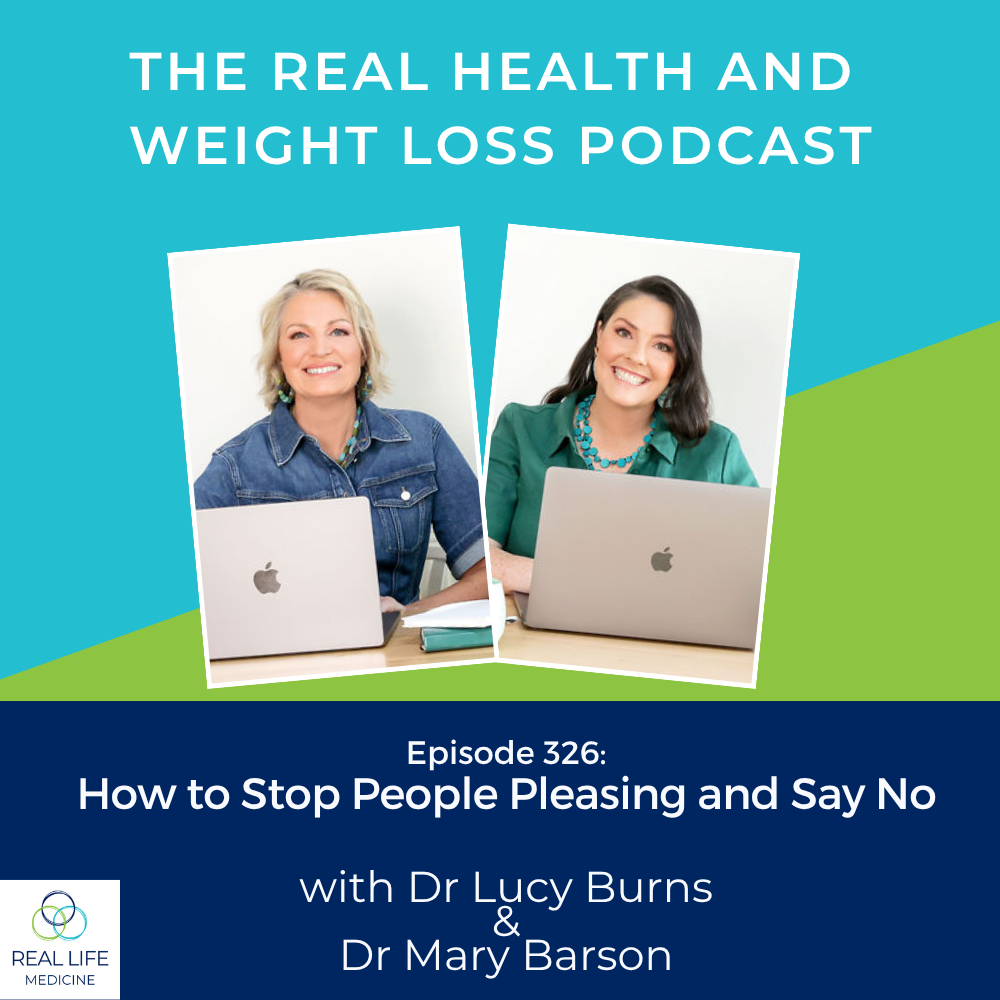

HOW TO STOP PEOPLE PLEASING
AND SAY NO
One of Australia's Most Popular Podcasts with Hundreds of 5 Star Reviews

Grab your FREE Ebook copy now!
Have you struggled to lose weight and keep it off?
Start your journey to boost metabolism and transform your body into a fat-burning powerhouse.
Episode 326:
Show Notes
Episode Summary
Dr Mary Barson and Dr Lucy Burns explore why midlife women so often put themselves last, and how people pleasing, caregiving demands and numbing habits quietly erode health. It is framed as the closing instalment of their mindset series.
The midlife squeeze
- Many women are in the "sandwich generation", caring for children and ageing parents at once, leaving no room for themselves.
- Dr Mary reframes the caregiving "burden" as simply high care demands. Neutral language makes acceptance easier and stops us wasting mental energy wishing things were different.
- Self care is the best shield against burnout, so it matters most exactly when it feels hardest to prioritise.
Where people pleasing comes from
- It is often a protective strategy formed in childhood, sometimes linked to low-grade trauma or undiagnosed neurodiversity such as ADHD.
- It brings genuine strengths, including strong empathy and reading a room, but the cost is subordinating your own needs.
- The shoes analogy: people pleasing is a pair of shoes that protected you as a child. They did not grow with you. Put them on the shelf with gratitude rather than treating them as a character flaw.
Numbing versus genuine rest
- Wine, endless scrolling and late-night snacking are often labelled "winding down" when they are really numbing.
- Better question to ask yourself, without judgement: what am I numbing from, and what am I avoiding?
- Self sabotage is not a real thing. It simply means you do not yet understand why you are doing the behaviour.
Daily renewal
- Drawing on Stephen Covey, daily renewal is the habit that makes all other habits possible.
- Renew the mind (reading, podcasts, puzzles), the body (movement, strength training) and the spirit (prayer, meditation, active relaxation).
Practical tools
- Create a pause. "Let me think about it, I will get back to you" buys time to answer on your own terms rather than automatically saying yes.
- Watch for self abandonment. Considering others is worthwhile, but nobody deserves to be abandoned, including by themselves.
- If you worry you are being selfish, you almost certainly are not. Genuinely selfish people never ask the question.
Navigating food pressure
- Prepare short scripts, such as "It looks amazing, but cake just does not agree with me." Express gratitude, then sidestep. No over-explaining or justifying.
- There is no such thing as passive cake eating. What you eat makes no difference to anyone else's physiology.
- Pre-empt where you can by telling people in advance. If refusing would genuinely be unsafe or explosive, you are allowed to choose the easier path. One slice will not cause diabetes.
- Distress tolerance is a learnable skill. Discomfort, whether from saying no or from craving more, always passes.
Work With Real Life Medicine
For a step-by-step approach to improving metabolic health in perimenopause, menopause and beyond, check out My Metabolic Action Plan. This doctor-led comprehensive programme gives you
Strategies to improve metabolism
Skills to develop mindset
Tools so you will implement!
Episode 326:
Transcript
Dr Mary Barson (00:05) Hello lovely friend, I am Dr Mary Barson.
Dr Lucy Burns (00:09) And I'm Dr Lucy Burns.
Both (00:11) We are doctors, weight management and metabolic health experts. We are the creators of My Metabolic Action Plan, your two-step map to real health and weight loss, which is in fact the name of this podcast. Join MyMap now at rlmedicine.com.
Dr Mary Barson (00:30) Hello lovely friend and welcome to this episode. I am Dr Mary, joined by my fabulous friend and colleague who is an awesome woman in her midlife. Hello Dr Lucy, how are you going?
Dr Lucy Burns (00:44) I am very well, Miss, very well. And you know what's interesting is that I've just turned 58 recently, so I'm towards the end of midlife and about to enter the glory years if we are dividing life into thirds.
Dr Mary Barson (00:57) Yes, indeed, yep.
Dr Lucy Burns (00:58) Yeah, it's interesting because I kind of, in my head, midlife extends to your 70.
Dr Mary Barson (01:05) Yeah, yeah, totally. Well I'm turning 45 soon, so it's my birthday this weekend. So I guess I'm in the middle of midlife, I guess. You are right, smack bang in the middle of it. In fact, yep, in the middle of midlife.
Dr Lucy Burns (01:15) Yeah, if we say that people live till 90 and that's an average, then yeah, you're just approaching the halfway mark.
Dr Mary Barson (01:28) Oh wow, wow, that is exciting. Yeah, I like that. And I'm very excited to know what the second half of my life will bring. And one thing that I want it to bring is a bit more emphasis on me and a little bit less emphasis on other people. I am, like many people, caught in that midlife caregiving trap. If it's a trap, midlife care, I'm gonna call it a trap. You know, I've squeezed between caring for my kids. Yeah, you're a sandwich. I'm in a sandwich, yeah. I'm a sandwich generation, a typical one of them. Caring for kids, caring for parents, and also have spent my life being a people pleaser. That is a difficult habit to break. I think it comes from lots of reasons. Partly was having some lowercase t trauma as a kid. Being a people pleaser helped keep me safe, helped me navigate difficult situations, helped me fly under the radar and not be noticed, which was very helpful in my childhood. And also, I think having undiagnosed neurodiversity as well as being diagnosed with ADHD in my 30s. And we just always felt this sort of low grade shame around my relative deficits with executive function, just not being able to be as organised as other people, not being able to stay on task as well as other people. Made me develop some pretty impressive masking strategies and coping strategies. But people pleasing was definitely one of those, just this low grade shame that was there, that I wasn't good enough. And so I had to overcompensate. And those two things together, the caregiving burden that I have, and that tendency to be a people pleaser, I think have been significant. They're currently very significant forces in my life. And that's okay. I'm aware of it. But there are things that I would like to change as I enter the second half of my life.
Dr Lucy Burns (03:38) Yeah, yeah. And as we've spoken about recently, you do, you have to be pretty proactive in, you know, the environment that we've created, we being the human race, has created for ourselves in Western society is not conducive to health. It is easy to do unhealthy things, and a bit harder to do healthful things. Health promoting behaviours are harder, or require a bit more friction or intention than what's the opposite of health promotion?
Dr Mary Barson (04:08) Health destruction. Health deterioration.
Dr Lucy Burns (04:17) Yes. Health. I know. I'm looking for whatever the verb of declining is. Declination is what my brain wants to say. But I don't think that's a word. The declination.
Dr Mary Barson (04:32) Degradation.
Dr Lucy Burns (04:33) Degradation. Yes, I think that's right. Health promoting versus health degrading. You're right. Yeah, we'll go with health degradation. So yeah, it is interesting, isn't it? The people pleasing. And also, I'm going to throw in there, and that other little concept we spoke about recently of noble procrastination, where it feels good for our brains to be looking after everybody else. And we can subconsciously use all our time on looking after everybody else instead of giving a sliver of time to ourselves.
Dr Mary Barson (05:09) Yeah, it feels important. And we often do value, you know, the caregiving demands. But when we let them take over everything, then there's no room or space left for ourselves, which is, I think, can be doubly bad, especially if you're someone with a high caregiving burden or high caregiving demands. That self care and looking after our health is actually one of our best shields against burnout. So it becomes even more important when we've got high demands placed on us, but it becomes much easier to ignore.
Dr Lucy Burns (05:47) Yes, it's so interesting to me that in times of stress and distress, when we really should be doubling down on the things that make us feel better and look after ourselves, of course, we revert to, you know, often numbing behaviours that are terrible for our health. Lots of people will be drinking wine, watching Netflix and not going to bed. Their brain is telling them that they're unwinding. But they're not. They're numbing, degrading their health. Yeah, doing health degrading behaviours. And I don't think we talk in society much about numbing, numbing stress, or we think it's wind down. That's what we'll call it, won't we? You know, I'm just winding down for the evening. I'm just having my time. And, you know, my time for me was always a bowl of ice cream or a block of chocolate on the couch watching back in the day, you know, something like Desperate Housewives. And again, it's not to say that you have to be always doing highbrow activities, you are definitely allowed to, you know, chillax watching a movie. But it's when it becomes something that you do every night and your brain is telling you this is my wind down. And it's not helpful for your long term health. We probably need to make some changes.
Dr Mary Barson (07:04) Yes. Steve Covey, the psychologist and author of The 7 Habits for Highly Effective People. It is a lovely book. I don't think that it's a lot of the stuff in it is particularly workable and 100% doable for someone in my circumstance. But it is a lovely book. He talks about daily renewal. That's the habits of daily renewal, being the habit that makes all other habits possible. So, and what he means by that is you have to look after yourself. If you don't look after yourself, then you can't do anything else. And this book is really all about living by your values, living your best life, doing the things that are important to you. It's not, you know, some Jimbro hack of just being more productive. It's a lovely book. But I really do love that concept that the self care, he calls it the seventh habit, that habit of daily renewal, is the habit that makes all other habits possible. So taking it back to the squished midlife woman with all of her care burdens, we've got these care burdens that are the people that we care about, that we want to care for, we've got our jobs, we've got our lives, we've got all these things, we can't do any of that, if you know, we're a broken down puddle on the floor. And so taking time for self care is important. He talks about the mind, body and the spirit. And I think that's kind of helpful as well. It's obviously not going to be, you know, not in all circumstances for all people. But spending some time renewing your mind, you know, listening to a podcast that is helpful, reading a good book, watching the news, like, you know, educating yourself or doing something that is useful for your mind. Even puzzles and sudokas and jigsaw puzzles can fall into that category. That can be good self care, caring for your body movement, strength training, and your spirit. And for him, it's prayer. But he also talks about meditation and active relaxation can fall into that. And it's a nice way to think about it.
Dr Lucy Burns (09:07) Yes, absolutely. So from a practical point of view, may I say for you, as you said, you've got high care demands. Interesting, isn't it? As you were talking about the word burden there, we could probably reframe that word, I reckon. Because when we've got, if we feel like we've got a burden, that feels heavy. Well, for me, that's my interpretation of it feels heavy and hard, like you, you know, you're lugging some bloody, you know, pile of sticks up a hill like it's hard. Whereas if it's just a high care demands or high care situation, even like even a more neutral word.
Dr Mary Barson (09:55) Yes, it just it is what it is. This is good. This is turning into a mindset coaching session for me. That's genuinely helpful. You're right, because I think the words that we use are important, and that it just is, it just is what it is. And we just, you know, work with what is, then that's much better than saying is a burden and wishing that it was otherwise and wasting our precious mental energy on thinking that it's not fair.
Dr Lucy Burns (10:18) Yeah, yeah, absolutely. And this you are right, the words we use do matter, because they change the way we perceive something, which is all part of the RAS. And so the concept of acceptance becomes much easier when it's just something neutral. You know, yep, you're a mum, you've got young kids. Of course, there's demands there, of course there is. I mean, you know, you can't leave your four year old to fend for himself in the wild. That's not possible.
Dr Mary Barson (10:41) He'd probably love it if I did.
Dr Lucy Burns (10:44) He probably would. For a while. If he was 24, and you were still doing his washing, then we'd probably need to have a chat. But I think this is something again, it's the acceptance of the life stage that is. Yes.
Dr Mary Barson (11:04) And it is, it's like, we can't always control our external environment. Just sometimes it just is what it is. But we have got the power and freedom within us to choose what meaning we assign to our situation. And with that, we also have the power and freedom to choose our actions.
Dr Lucy Burns (11:22) Yes. Yes. And thinking, therefore, about the actions that we're doing and an example being we talked about, you know, scrolling on your phone, drinking wine, not it is numbing. It's also then about, okay, well, what am I numbing from? Can I change the way I think about that? Am I avoiding something like these are all curious questions that you can ask yourself. And they're not judgments, they're just questions that will help peel away that onion layer so that you can understand yourself and understand the behaviours you're doing. You know, which is what we spoke about in our episode a couple of weeks ago, around self sabotage, self sabotage isn't a thing. It just means you don't understand why you're doing the behaviour you're doing yet. Yes, that's it.
Dr Mary Barson (12:12) If you feel the need to sit on the couch watching Netflix, eating a bag of corn chips at night, because it's your time, it's your time, because it's not fair that, you know, I have to do all these things for other people, because I deserve this, because, because, because it could be helpful to unravel that a little bit, spend a little bit of time on reflection, and reflection, a few moments of reflection can be part of that daily renewal.
Dr Lucy Burns (12:38) Absolutely. So as you were talking then, earlier about, you know, people pleasing, and, you know, we can understand that, yes, that comes from sometimes, you know, avoiding conflict, it keeps you yourself safe, particularly when you're a little kid. But it can transition into adulthood as well. And most people who identify as people pleasers, they don't like it. No, but I don't know anybody who says I'm so happy. I'm a people pleaser. I'm so happy about that.
Dr Mary Barson (13:11) Totally. I think it can be a strength and a liability. I think I could acknowledge some of the useful things about it. I'm extremely good at empathy and picking up on the mood of everybody in the room. It's part of my natural ability, but also a skill that I have honed, because that helped keep me safe, understanding where we like, what was the mood on the room? And what could I do to appease, avoid, navigate. So that's actually clinically, it's helpful, I can, and in meeting, it's helpful, I can, I can often see the problem coming before anybody else can, and I, I don't understand why nobody else is taking action. Can't you see this person is about to, oh, there they go. Yeah. That's helpful. But yes, I often, I don't like how I can subordinate my own needs for the needs of other people. I think that that is extremely unpleasant. And I can get a little reel in my head going, oh, you're so weak, you're so, such a pushover, you're so, this is negative talk. So what is helpful for me is acceptance, and just understanding that this isn't a character flaw. It's not. It is something that my brain developed, and it had a role, and it was really helpful. But it's sort of not helpful anymore. We've talked about this analogy before, and I love it. It's so this tendency to people please to be able to, you know, figure out how everybody's feeling, deciding how can I make them feel better? How can I appease them? What can I do? It's a pair of shoes that I had when I was a kid that helped protect me. And I could walk through my life with relative protection with these shoes on. But the thing is that the shoes didn't grow. And I did. And now trying to jam my 45 year old, nearly 45 year old feet into these children's shoes is going to be painful, uncomfortable and not helpful. That doesn't mean that the shoes were terrible. It just means I don't need them anymore. So with love and self kindness, I can put the shoes on the shelf, thank them for being helpful, and I just don't need to wear them anymore.
Dr Lucy Burns (15:19) I love that, May. It's like, I love, it's such a kind way to think about yourself and to recognise that, yeah, they were a tool that were really useful for you when you were seven. But now, as a 45 year old, you don't need them anymore.
Dr Mary Barson (15:34) No, it doesn't mean I'm weak. It doesn't mean I'm broken. Doesn't mean there's anything wrong with me. It just means that this tool is just not helpful anymore. But my brain does remember when it was helpful. And my brain does still want to reach for this small pair of shoes. You know, that still happens. And one of the most useful things that I have, a skill that I've developed to overcome that is to just give myself a bit of time, just a bit of pause. Hey, Mary, can you do this incredibly inconvenient thing for you that will make my life slightly easier? My inside voice goes, yes, I'll do it. And, and I just need to take a little moment and just create a pause. And so now my answer is, I'll go back to you. I'll think about it. Give me a minute. I'll just check a few things. I have all of these little tools, because I, and it creates a little bit of stress and discomfort for me, because I want to say yes, but I don't. And then with a little bit of space, I then have time to, you know, craft a response, which is, I might decide to do it, but I will decide to do it on my terms, or I'm sorry, I can't. That is the most helpful thing, most helpful tool I have developed.
Dr Lucy Burns (16:47) Yeah, I love that. I love that. And I think it's, um, I've heard a phrase, self abandonment, which I really like in that, when we can use that thought or that word to help ourselves, because when you abandon your own needs, it's not about being selfish or unselfish, but nobody deserves to be abandoned. And so we can use that idea of, oh, okay, yes, I've abandoned my needs, because I'm picking up somebody else's instead. And we don't deserve that, we deserve to be not abandoned. It's tricky, because our brain, we have often been conditioned, even if we weren't, you know, in a trauma situation, we've often been conditioned, particularly as women, or as girls, to consider other people, to be considerate. And, again, like everything, there is absolute merit in that. We do not want to live in a society full of selfish assholes. But quite often, that consideration comes with self abandonment. And I think that's where the line probably needs to be drawn. You can absolutely consider other people's needs, consider other people's feelings, but yours matter too.
Dr Mary Barson (18:04) That's right. And you, you don't have to be a complete asshole who cares about no one. But at the same time, you don't have to completely abandon yourself. I was reading an article about method acting, and that someone wrote a thoughtful article about the difference between women who engage in method acting and men, and men who, I think Jared Leto did this in The Joker, where he was just, he just did really, really, really rude and toxic and damaging things to his co workers while staying in the role of the Joker at all times, just constantly acting out that villain. And yeah, he was, he was doing terrible things to them. Whereas, yeah, I was like, sending them gifts of dead animals and like, just terrible stuff. It's totally out of line. And the author of this article is reflecting that women rarely do that, and interviewed a few women who engage in method acting. And the idea was like, yes, yes, you know, acting is inherently vulnerable. You're taking on a role of someone else. It's not very macho to pretend to be someone else. And you can get absorbed in the role without being a complete asshole about it. That's sort of generally how women take it. It's like a little reflection on just the gender differences in our society.
Dr Lucy Burns (19:24) Yeah, absolutely. And I think for any women out there who, and look, and men, there are men who are people pleasers, absolutely, men who've been victim of trauma as well. So this is not just a female thing. But if anybody is out there who was worried that their behaviour might be perceived as being selfish, well, you're already not. Because selfish people don't actually ever think that.
Dr Mary Barson (19:50) Yes, yes. Very good point.
Dr Lucy Burns (19:53) You already have way more self awareness and you're not being selfish. You may be being, you know, prioritising your needs some of the time. And that is, I mean, perfectly acceptable and what we need to do. An interesting scenario that comes up a lot is when people are wanting to follow a food, potentially a food plan. They've got their ideas around what they want to eat or not eat. And they feel pressure from other people to not follow their plan or to eat what the other person's eating. And it's interesting on how people navigate that. And I've heard all sorts of thoughts, and I understand, you know, somebody wants you to eat the cake they've made. You know, you've gone over to their place for morning tea and they've made cake, and suddenly they present it to you. How do you navigate that? You know, maybe you want to eat the cake, in which case, then have the cake. But if you don't actually want to eat the cake, and that's where the disconnect can happen, then what sort of advice do you give people, Miss?
Dr Mary Barson (21:01) Yeah, I think having some pre prepared little scripts can be helpful, because then it gives you that moment. Like when things have sprung on you, we can often want to default to what our brain knows best, you know, putting on those, you know, uncomfortable, self people pleasing shoes, for example. But just having a few little scripts can be helpful. Like, oh, I'm so sorry, it looks amazing. Cake just doesn't agree with me. That's helpful. Most people aren't going to argue with that. You don't need to get into a big thing about how I'm on a diet, I am self restricting, I am, you know, sanctimonious and thinking that you're gonna make that person feel bad. Just little things like that can be helpful. Expressing gratitude, and then just a quick little sidestep, and keep your comments sort of clipped and short, you don't need to go into it. And that's quite helpful.
Dr Lucy Burns (21:52) Yes, I think that is the exact sentence because you're right, again, as people pleasers, people are often prone to over explaining. So all of a sudden, there becomes all of this thing, and they, you know, go through everything. And it's like this, you don't need to justify your decisions. The way I like to think about it is that if, if there are two people in the room here, one of you wants you to eat the cake, the other one doesn't want you to eat the cake. One of you is going to be unhappy, might as well be them. It's pretty blunt. But the thing about it, right, is that, and again, we can come back to physiology here, if we want to. Physiologically, it makes no difference to their physiology, as to what you choose to eat or not eat. So, you know, this is different to, say, smoking. If someone decides to smoke, and it's in your presence, well, you have to endure that smoke, that smoke goes into your lungs, you get the effect of that smoke. If somebody is eating a piece of cake, nothing happens to you.
Dr Mary Barson (23:03) Yeah, there's no passive cake eating.
Dr Lucy Burns (23:04) No. So there is no difference to their physiological state, whether you eat the cake or not. Now, again, there are circumstances where that is easier than other circumstances, depending on the history of that person, the relationship with that person, you know, what that person, you know, their, their own stories around you eating their cake and all that sort of stuff. And I get all of that. That's, I think we need to be really, I don't want to diminish the uncomfortable nature of this situation. So options are definitely, you can go, oh, it does, looks amazing. But you know, sadly, cake no longer agrees with me. And so, you know, they go, what do you mean? You go, you don't want to know. And that's kind of that can be, that's a sentence that's finished. You may decide that you are going to go, look, I'm actually prioritising my health. And I just really want to taste, like I can't, I don't want a whole piece. Okay, you might want to do that. Again, you're the boss of you, get to decide. You may decide that, look, I don't know this person, you know, might be, might be your mother, for example, might be your sister, you've got long standing difficulties. And if you, you may know that to refuse is going to cause nuclear fallout. Okay, well, then you know, you, you again, all it's all about you. So you get to decide how you want to navigate it. And if it feels safer for you to eat the cake, then not eat it. Okay, well, then you can eat the cake. And it's, again, it's not going to suddenly get you to, you're not going to suddenly develop diabetes from eating one piece of cake. But it may be helpful, though, to know to preempt, if you have those sorts of people in your life, who are going to be really upset with you for not eating whatever food they've potentially produced. And they might not even made it, might be some, you know, Woolies cake, like rubbish. Yeah, you can preempt, you can, before you go over there, you can go, look, I'm just letting you know, I'm off cake for the moment. You know, I'm not doing any cake. So you've told them in advance, there's nobody's getting surprised if they then produce the cake, you told them, there's many ways to skin a cat as the great Australian terrible saying goes. But at the end of the day, what we want is for you to make decisions that you're happy with, that, you know, without self abandonment. But recognising that sometimes you do have to because it's safer. And that's a skill that you can learn to develop over time.
Dr Mary Barson (25:44) Yeah. And in many of those circumstances, there's a little bit of, like, distress tolerance might be required as well. If you're saying no, you have to sort of sit with the discomfort of that. If you're saying yes, and if you don't want to, have to sit with the discomfort of that. If you have a little slice of cake, it might make you want more, and you have to sit with the discomfort of that.
And it's okay to be uncomfortable. And but just being aware that you might just have to sit with this for a little while, it'll go away, but you have to sit with it for now, could also be helpful.
Dr Lucy Burns (26:11) Absolutely. I forgot all about distress tolerance as a concept. You're right. I mean, it's absolutely doable. We, it's again, another skill, you just have to hone it. We are allowed to be uncomfortable. We might not like it, but it is, it will pass. Yes, everything passes. All right, my lovely ones. So hopefully that's been helpful. That's probably the end of our mindset series for the moment. But we will be back next week with another episode of the Real Health and Weight Loss podcast. We'll talk to you then.
Dr Mary Barson (26:37) See you, beautiful people.
Dr Lucy Burns (26:40) The information shared on the Real Health and Weight Loss Podcast, including show notes and links, provides general information only. It is not a substitute, nor is it intended to provide individualised medical advice, diagnosis or treatment, nor can it be construed as such. Please consult your doctor for any medical concerns.