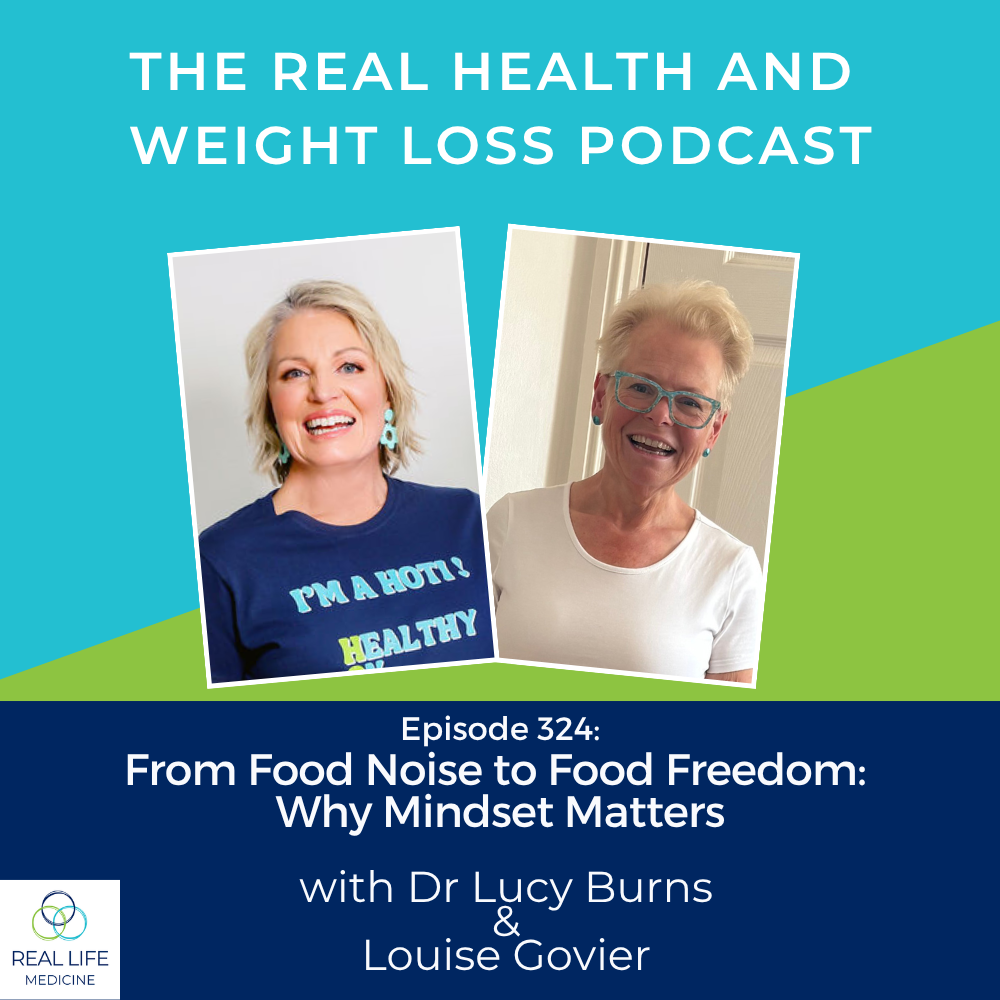

FROM FOOD NOISE TO FOOD FREEDOM:
WHY MINDSET MATTERS
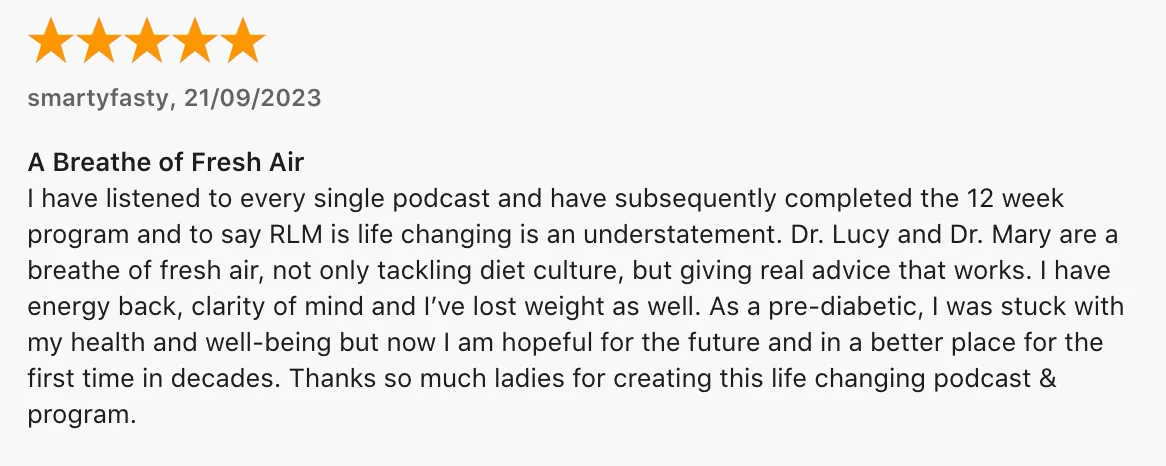
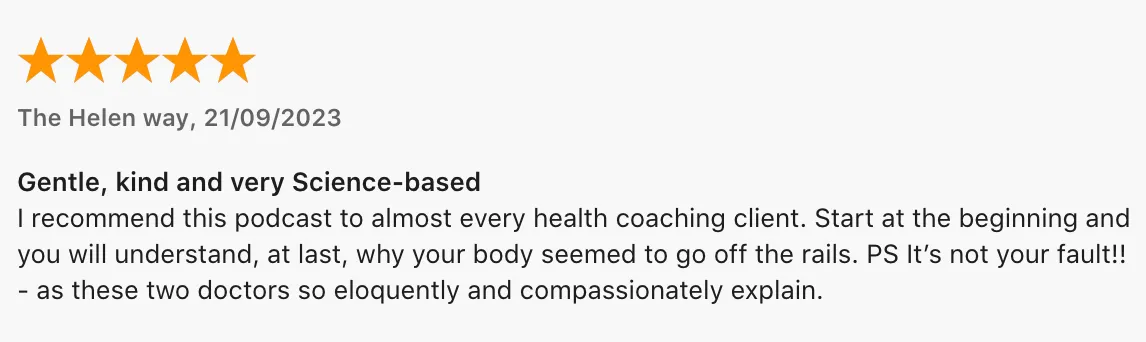
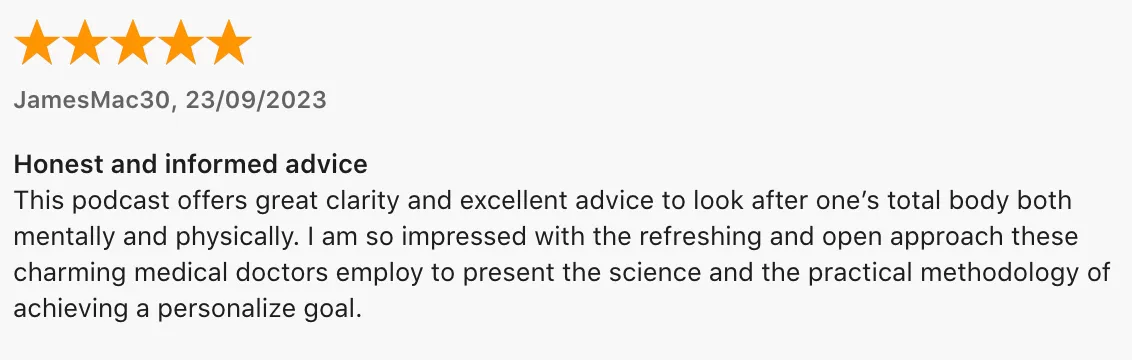
One of Australia's Most Popular Podcasts with Hundreds of 5 Star Reviews

Grab your FREE Ebook copy now!
Have you struggled to lose weight and keep it off?
Start your journey to boost metabolism and transform your body into a fat-burning powerhouse.
Episode 324:
Show Notes
This episode shares Louise Govier’s real-life experience of improving her health through low-carb real food, mindset skills and consistent lifestyle changes. Her central message is that sustainable progress came not from perfection, but from learning how to manage food noise, emotional eating and the everyday behaviours that had kept her stuck.
Episode summary
Dr Lucy speaks with Louise Govier, a 59-year-old woman from England who had lived with significant excess weight for much of her adult life. Louise had previously succeeded with a lower-carbohydrate approach, but regained weight after her earlier programme shifted towards a more conventional “everything in moderation” model, compounded by illness, a back injury and the disruption of COVID.
After seeing Dr Lucy’s talk on sugar addiction, Louise connected with the idea that her challenge was not “food” as a whole, but particular highly palatable foods and the behavioural patterns around eating them. She joined Real Life Medicine and began applying a low-carb real-food approach alongside mindset work, emotional regulation tools, movement, sleep, meditation and intermittent fasting.
Over roughly four years, Louise reports losing seven stone, approximately 45 kg, moving from a UK size 22 to a size 10. More importantly to her, she has reduced the constant mental preoccupation with food, improved her strength and fitness, and developed practical skills to maintain her health long term.
Key points
- Food noise was a major issue. Louise describes persistent thoughts and urges around food, particularly sweet foods such as chocolate, sweets and lollies. Once she stopped eating these, her brain initially searched for acceptable substitutes, including nuts and other low-carb snacks.
- The issue was not all food. A key turning point was recognising that she did not need to “give up food”, but could identify and step away from the specific foods that triggered cravings, overeating and loss of control.
- Individualisation matters. Dr Lucy highlights that there is no one-size-fits-all dietary protocol. Some people can include certain carbohydrate-rich foods without difficulty, while others find foods such as bread, pasta, sweets or snack foods hard to regulate.
- Mindset skills were as important as food changes. Louise found that managing her emotions, urges and habitual responses was central to progress. She created a visual “mindset toolbox” so she could choose a helpful tool in difficult moments, such as pausing, breathing, tapping, noticing emotions, meditation or hypnosis.
- Food can become an emotional coping tool. The discussion acknowledges that using food to soothe emotions is understandable, particularly when it has been a long-standing coping strategy. The goal is not shame, but building a broader range of ways to regulate stress, discomfort and emotions.
- Consistency quietens the brain over time. Dr Lucy’s “dog on the couch” analogy illustrates how repeated reinforcement strengthens a habit. When a boundary is held consistently, the brain eventually stops pushing so hard for the old behaviour.
- Language can make boundaries easier to accept. Louise prefers the word “guardrails” rather than “rules”. For her, guardrails feel protective rather than restrictive, helping her make choices that support her long-term health.
- Weight-loss plateaus require patience and reflection. Louise found the middle stage challenging, when she was eating well and building healthy habits but weight loss had slowed. Refocusing on genuine hunger, reducing non-hungry eating and allowing time for habits to settle helped her continue.
- Intermittent fasting became a useful tool. Louise gradually explored fasting and eventually found an approximate 18:6 eating pattern worked well for her. She reports that eating less frequently helped reduce food noise, although she emphasised this was developed gradually and as part of a broader approach.
- Health change was multifaceted. Louise’s progress involved more than changing food. She now uses daily meditation, improved sleep, morning sunlight, strength training three to four times per week, cardio, hypnosis, sauna, ice baths and social connection.
- Strength training changed her sense of capability. Despite initially believing her back injury limited her, Louise now feels stronger, fitter and healthier at 59 than she did in her twenties.
- Maintenance requires ongoing awareness. Louise sees maintenance as continuing the practices that created the result. She has learned that some foods, such as sourdough, may be manageable occasionally when out, but are harder to regulate when kept at home.
- A lapse does not need to become a spiral. Louise uses the image of “snipping the thread” to interrupt an unwanted pattern at any point in the day. Rather than waiting for tomorrow or Monday, she can choose to reset with the next decision.
Standout quotes and concepts
- “It wasn’t all food, it was this particular type of food.”
- “My brain is always looking for a loophole.”
- “The biggest thing for me is about my brain.”
- “I call them guardrails because there is a little bit of my brain that will rebel.”
- “More than having lost weight… having less noise in my brain is the loveliest thing.”
- “We know what to do. I just have to believe I can do it and then keep showing up.”
- “I can just go at any point of the day, snip. I’m stopping that now. I start again.
Practical takeaways
- Identify your personal trigger foods, rather than assuming every food needs to be treated the same way.
- Notice the difference between physical hunger and a non-hungry desire to eat.
- Create a short, visible list of coping tools for moments of stress, boredom, discomfort or cravings.
- Choose language that supports you. “Guardrails”, “guidelines” or “boundaries” may feel more helpful than “rules”.
- Focus on building a repeatable lifestyle: real food, adequate protein, strength training, sleep, stress management, sunlight and connection.
- Expect your brain to bargain, negotiate and seek loopholes when changing a habit. This is not failure, it is part of the process.
- Interrupt slips early. You do not need to wait for a new day, week or month to make a different choice.
- Learn which flexibilities are genuinely sustainable for you, and which foods are easier simply not to keep at home.
What happens when you stop chasing the next diet and start building the skills to manage your own mind?
In this inspiring member story, Dr Lucy Burns speaks with Louise Govier from the UK about her journey from decades of dieting, food noise and frustration to greater health, strength and self-trust. Louise shares how identifying her personal trigger foods, embracing low-carb real food and developing a practical mindset toolbox helped her lose seven stone, reduce emotional eating and feel fitter at 59 than she did in her twenties.
This is not a story of perfection. It is a conversation about consistency, guardrails, self-compassion, strength training, fasting, food noise, setbacks and learning how to reset at any moment.
Work With Real Life Medicine
For a step-by-step approach to improving metabolic health in perimenopause, menopause and beyond, check out My Metabolic Action Plan. This doctor-led comprehensive programme gives you
Strategies to improve metabolism
Skills to develop mindset
Tools so you will implement!
Episode 324:
Transcript
Dr Mary Barson (00:05) Hello lovely friend, I am Dr Mary Barson.
Dr Lucy Burns (00:09) And I'm Dr Lucy Burns.
Both (00:11) We are doctors, weight management and metabolic health experts. We are the creators of My Metabolic Action Plan, your two-step map to real health and weight loss, which is in fact the name of this podcast. Join MyMap now at rlmedicine.com.
Dr Lucy Burns (00:29) Good morning, lovely friend, Dr Lucy here. You might be getting a bit sick of Dr Mary and myself yabbering on. So I thought I would bring on a special guest. And I am so excited to bring on this guest because, you know what, she's probably just like many of you out there. She's a real woman who was just living her life, but not particularly thriving. And I thought, you know, we've had a lot of experts on recently, why don't we just have a real life story? So I'm super happy to introduce you to my friend Louise Govier. She is fabulous. And on top of all of that, we are on opposite sides of the world. So she's from England. I'm in Australia. And with the power of magical television-y hoo-ha, we are talking together. So Louise, welcome to the podcast.
Louise Govier (01:20) Thank you. Thanks for having me.
Dr Lucy Burns (01:22) It is our pleasure because I think, you know, I know that's a cliché, your story's inspirational, yada, yada, yada. And we're not about clichés here, but I think that there is so much of your story that other women will relate to or resonate with. And I think them hearing it will be, you know, potentially motivating or, I guess, bringing some hope. So yeah, I thought we would talk about, you know, maybe start with where you were and how you were feeling, and then we'll just see how the world unfolds. So I guess, tell us a little bit about yourself to begin with.
Louise Govier (02:01) Yeah, sure. Well, I am 59. I can't believe that. I'm going to be 60 in a few months' time. I work, I have caring responsibilities, like lots and lots of other people. And actually, for most of my 59 years, I was overweight, sometimes a bit overweight, but often significantly overweight. And I would say that for most of my adult life, I was really, you know, six, seven stone overweight for a long time. And I had some early success with a low carb approach, not through Real Life Medicine, actually, but I was doing really well with it. And then actually, weirdly, that program kind of moved away from that and moved into a sort of, oh, you need to have a little bit of everything, really, you need to, and I tried to, and then suddenly, it had all gone very pear-shaped. And then COVID happened, and I got sick, and then it hurt my back. And suddenly, I put really a lot of that weight back on. And then I saw you on a TED Talk, talking about sugar addiction. And I thought, oh, my goodness, this lady is talking about me. I need to find out more about this. And actually, that's how I started to make the changes that have helped me to get to where I am now.
Dr Lucy Burns (03:23) Ah, awesome. So, so that was how long ago was that?
Louise Govier (03:28) That was probably four years ago, something like that.
Dr Lucy Burns (03:34) Yeah. Yep. Yeah. Okay. And so when you were thinking about it, how were you, how are you feeling about yourself, I guess, at the time?
Louise Govier (03:42) Oh, I was, I was kind of fed up. I was cross. I was really bored. I was really bored with the fact that I was overweight. And I knew, I knew so much about how not to be overweight. And yet, I apparently couldn't put it consistently all into practice without something, real life, stress, whatever, getting in the way. So I was bored and cross and a bit hopeless. I was like, this is never gonna, it's been years, I am never going to crack this. Even when I'd lost some weight, I still felt a bit like, well, that's great. But to the rest of the world, I'm still overweight. I'm still nowhere near a healthy weight range. So how am I ever going to lose this last chunk, which was quite a lot? So yeah, hopeless, cross, frustrated, pouty-lipped.
Dr Lucy Burns (04:31) Pouty-lipped. Yeah. And I think it's understandable because it feels like it's insurmountable sometimes, doesn't it? And just feels frigging hard.
Dr Lucy Burns (04:41) It's interesting then that your, the previous program moved away from low carb.
Louise Govier (04:50) Yes. Very gradually. Yeah. It just seemed to be very gradually less about that. When we started, it was kind of, you know, really limiting your carbs and it was lots of similar messaging. And then it just seemed to move away into, well, no, actually, it needs to be balanced and not too much of anything. And then actually, I just found out that it wasn't, I have a lot of food noise. Food noise is a thing. I know it's not for everyone, but it is for me. And it just seemed to be raging away. And it wasn't until I found Real Life Medicine that I thought, ah, do you know, I used to do much more of this kind of thing. And I think that worked for me. And now I haven't been, so I don't know why they did that, but maybe because some people find the idea of stopping eating carbs or certainly stopping eating sugar. I, I find that people find that very challenging as a concept. So maybe it wasn't helping their business model, but yeah, for success, it wasn't good for me.
Dr Lucy Burns (05:48) Yeah. Look, it's, it's tricky. I think there are, there's a lot of protocols out there that people have. And, and I think the thing is that there is no one size fits all. There's no, you know, you must do this. You must do that. But I think what I find that is helpful for most people, particularly if they do have predilection to rely on carbs, that it is easier to have none than some. And that's not to say that you're cutting out an entire food group because you do get plenty of carbohydrates still from vegetables, but it's just not that hyper palatable form. So you mentioned that you were, you know, you're feeling pretty rubbish. And when you first started then, how were you feeling then? Can you remember?
Louise Govier (06:39) Yeah, absolutely. I felt like this was hopeful. And to some extent, this is something I've experienced through my life with eating that actually a new plan is quite a hopeful time. And you think this could be it. And then there's also the thoughts of like, well, you've thought that before and it wasn't, but actually thinking, do you know what? I can do this. This is okay. My biggest revelation, which came in week one of doing the sugar free reset, as it was at the time, was that actually, this might be my answer, because I had so often felt that I was just addicted to food, addicted to eating. And yet, how do you not eat because you have to eat for sustenance? And you couldn't be like an alcoholic, that's like, I'm never going to touch alcohol again, I'm never going to touch food again. And yet here was the thing, it wasn't all food, it was this particular type of food. And actually, I could put that food down. And that was almost immediately, really a good thing for me. Really good.
Dr Lucy Burns (07:44) Yeah. And you know, I think you're right, there is some quite a lot of parallels between, you know, sugar addiction. And we talk about sweet sugar and savory sugar, because the sugar could be bread or pasta. It's not usually broccoli, even though there are carbs in broccoli, it's not usually vegetables, it's the sweet sugars or the savory sugars. And they are potentially hyper palatable for some people. But even within that, there are people that can moderate rice, for example, but they can't moderate bread. So it is quite individualised. But the parallel to alcohol is that alcohol is fluid. So people don't have a fluid addiction, or a liquid addiction, they've got alcohol addiction. And it's the same with food. I'm not a big fan of the food addiction, either. I think it's the particular food addiction. So particular foods. So what was your kryptonite?
Louise Govier (08:52) Oh, well, a lot of it also shades into behaviour for me, which is why I found this program so helpful. So my kryptonite were sweet things for sure. Chocolate, sweets, lollies, as I learned, they're called in Australia. But actually, there is something for me around just eating, I have non hungry desires to eat. So I can. And then one of the things I found I was doing was transferring that kind of behaviour to other kinds of food, which could be nuts, which could be, you know, the whole snacking thing. So I almost can't even remember, it wasn't a particular thing that I would crave. But it certainly started out as sweet things. And then when I stopped having those, my brain was kind of ready with, Oh, well, if we're not having that, can we have this instead? Let's, that fits the rules. So I have a very, my brain is, I mean, it's extraordinary. I kind of admire the resilience and ingenuity of my brain to kind of come up with more ways round whatever guardrails I'm putting in place.
Dr Lucy Burns (10:05) Oh, yes. Yes. The brain is always looking for a loophole.
Louise Govier (10:09) Yeah, it could be like, you know, the most extraordinary business negotiator somehow. And yet, that's not what we're using it for.
Dr Lucy Burns (10:19) No, no, no, no, no, it is. It's quite amazing, isn't it? It seems to be able to make up what we like to call the reasonable story. You know, it's a reasonable, it's reasonable what you're doing. And it's and it and you know, I can justify its way out of anything. Really, it is like negotiating with a terrorist.
Louise Govier (10:35) Yeah.
Dr Lucy Burns (10:36) Yes, yes. So I know you, you were part of our Momentum program. And we had a month called the My Mindset Toolbox. And it was going through all of the skills, I guess, that we teach people. And you came up with the most fantastic drawing that we have now used in many of our webinars. But tell us a bit about that.
Louise Govier (10:58) Yeah, well, for me, this was the biggest revelation for me about being part of Real Life Medicine, was I loved the emphasis that you put on mindset tools, because actually, the biggest thing for me is about my brain. And I totally get that what I eat will affect that. But even then, it is how I manage my brain, my emotions, my desires to eat, which are kind of all the time, you know, how do I manage all of that? And I realised at a certain point that I knew, actually, at this point, when you did this focus, I knew that there were lots of things that I had already learned to do. But I really struggled to remember them. In the moment, I would just be like, oh, I can't do this. And actually, then think, no, but you know, you can, you can do this. Go and just look in your folder, work out one of those tools. And of course, my tools were all all through my notes in my folder. And I thought, actually, we're talking about a toolbox, literally make a toolbox, one piece of paper that you can look at and go, what is it that I need right now? Do I need to stop and pause and take some breaths? Do I need to do a bit of tapping? Do I need to note an emotion and let it go? I do a lot of noting and letting go. What is it? And so I drew this box with little compartments in it. And then thought, you know what, that actually looks like my actual toolbox with the nails and the screws bit in the top. So I just drew a pattern around it, which pleased me. And I still use it. I use it yesterday, because I was just, you know, in a bit of a, what am I going to do? And I was like, oh, actually, do you know what, I'm having some uncomfortable feelings. And I need to listen to my hypnosis, your hypnosis about the forest of uncomfortable feelings, and let my uncomfortable feelings go rather than attempting to tamp them down with low carb real food, but still more food than I need.
Dr Lucy Burns (13:05) Yeah. And I think, you know, you've just hit the nail on the head there, because we, we use food to soothe emotions, we use it to regulate emotions. There's nothing inherently wrong with that until it becomes our only tool, or until it starts to cause us some harm in some other way. So it's sneaky, because you know, it's not, it's not the same as taking arsenic or taking drugs, for example, which are not harmless, at any level. There is a component where there's no consequences initially. So we learn this tool, and it works. And it's often all that's available to us, particularly when we're younger, or little, or, you know, you're in the house, and you're seven, and you can't drive, all you've got is the cupboard. So learning to identify, I guess, the emotions, and how to regulate these emotions, and soothe yourself without food. I mean, for us, it's obviously the linchpin of everything we try and teach.
Louise Govier (14:11) And it's, it was revelatory for me to realise that I had all these things at my disposal, that you'd helped me to learn. I mean, I don't manage it all the time. Even now, I do not manage it all the time. But there's a bigger chance that I'm going to if I've got that kind of array of things in place. And the other thing that I know, at this point in my journey, is that it helps me anyway to do that. Because if I give in to this urge to soothe in that way, using food, all that's going to happen is my brain is going to keep going. Oh, yeah, do that, do that, do that thing. Again, you tell this great story. It's in your after dinner snacking course, which again, was one of my early ways in, and I still watch that every now and again, about needing to train the dog to stay on the floor and not keep jumping up onto the couch. And that is my brain. And I know that if I give in to this urge, it will just keep coming and going, oh, yeah, there's a way in there. And it will only take a couple of days, it will only take a couple of days to get my brain to calm down, and it will stop suggesting that I snack or eat something to feel better. Or at least, it won't miss the stop, stop, stop, but it'll get a lot less noisy. And that's a lovely place to be compared to where I used to be when it's a quieter time. Oh, my goodness, that is the Shangri La, actually. More than having lost weight or even feeling fitter or whatever, it's having less noise in my brain is the loveliest thing.
Dr Lucy Burns (15:50) Yes, yes, you and I are very similar in that department. I remember, yeah, all the time I used to do my brain was on sugar. What can I have now? What's next? What's next? Every event was all about the sugar. Every, you know, going to the movies, oh, goody, that means we can have lollies. Everything was all about what can I have that seems, you know, justifiable. Because, you know, between doing sneaky eating, where I was eating by myself, which I didn't really love the idea of, I mean, I did it, but I didn't feel that good about it. But I felt good about it. If everyone else was doing it, it was like, right, well, we're all in, we're all in, we're all scoffing lollies. Everything was all about the food.
Louise Govier (16:27) I have to have popcorn. There needs to be popcorn because we're at the movies. And it's almost wrong. It's almost, you know, not, and it's not helping the business of the cinema if I don't have popcorn. It's like, come on, brain.
Dr Lucy Burns (16:40) Yes, yes, I know. Yes. And so for those of you at home who haven't heard the story of the dog on the couch, I will tell you it. So the dog on the couch, I know these days, everybody has their dog on the couch. In fact, people have their dog on the bed or in the bed. Nobody puts their dog outside like the old days. I get that. But let's pretend. So the story of the dog on the couch is you're on the couch and you're watching telly and the dog's got a lovely basket and the basket's fine. It's got, you know, plenty of padding. The dog's comfortable. Dog's quite a fluffy dog, sheds a lot of hair, but it's all in the basket. So everyone's happy. Everyone knows the rules. Then one day you come home from work and maybe you're a bit tired or you're a bit grumpy or you're a bit something sad. And so you kind of go to the dog. Oh, oh, come on, Bubba, up you come. And the dog can't believe it's luck and it's going, oh my God, it's leapt up onto your lap and everyone's happy. The dog's so happy and you're so happy and you're watching the telly and you're feeling much better and you're petting the dog and it's loving you and it's looking at it in your eyes and we're all happy. And then you hop up and you go, oh my God, I'm completely covered in dog hair. Bugger. Oh well. And so you put those clothes in the wash and then, you know, the next day doodles round and you hop on the couch and before you can even notice it, the dog's in your lap and you go, oh, oh, I wasn't quite finding that, but oh well, you're here now. Might as well, might as well keep going. And so you pet the dog every night and everyone's happy, the dog in particular, you're happy. And then you hop up and you go, oh God, covered in dog hair again. Now the couch is covered in hair. Oh yeah, we're not going to keep this going. But every night that week, the dog just leaps into your lap and it's sort of nice. But every night when you go to put the dog out, you go, oh my God. And so you get to the end of the week and you've actually got no clothes left. You know, you're sick of vacuuming the couch and the washing machine's full of dog hair. And it's like, ah, now there's a line in the sand. This is getting ridiculous now. And so you have a big chat to yourself. And so the next day you've talked to yourself all day. The dog is not coming on the couch. So you go to sit down. And of course, the first thing the dog does is leap up and try and hop in. You go, no. And you're having this little wrestle with the dog and you put it back in the basket. The dog's a bit confused and it tries to hop out and you're very firm, putting the dog in the basket. And then, of course, it's looking at you. Come on. It's pleading. It's begging. And you kind of go, no, no, no. And you feel a bit mean and you're a bit conflicted, but you just know. And so you get through the whole night while the dog's been giving you the dog eyes and you're feeling a bit, but you made it. And so, you know, you put the dog outside that night and you don't have any dog hair all over you. And so that's good. So you've got more clothes to wear the next day. And then the next day the dog kind of goes, how about it? And it hops out of the basket, but it's not quite as enthusiastic and you're able to put it back in the basket a bit easier. And, you know, it stops giving you the eyes. It just sort of goes, all right. And then the next night, same thing happens. It has a little crack, but it's really not nearly as hard. And then by about the fourth night, it just hops in its basket, doesn't even bother. And all of a sudden, peace is restored. You've got your clothes. Everyone's happy. Dog's going, all right, this is the new rules, but fine. And so I think that when we change what we do with anything, that it is hard at first, but the more we do it and the more consistent we are, and the new ground rules are established for our brain, it becomes easier and easier. And I think that's probably what you found, Louise, by the sounds of things.
Louise Govier (20:20) Yeah, absolutely. And another concept that you introduced, which is a bit like this, around the rules, was that I don't even call them ground rules now. I call them guardrails because there is a little bit of my brain that will rebel. I'm kind of a good girl, but also at the same time, there's a rebel in me. And if you tell me, or if I tell myself, I'm going to do this, these are the rules, I immediately want to work around them. Whereas when I call them guardrails and think of them as being a kind of a safety rail that enables me to stand at the edge of a beautiful waterfall and look over and not actually fall in, then again, I can deal with that. And it's a helpful boundary rather than a rule because I'm not very good with rules.
Dr Lucy Burns (21:07) Yeah, absolutely. And this is the power of language, isn't it? Because all that does, the language helps you reframe something. It's the same concept. One's called a rule. One's called a guardrail. One's called a guideline. You'll have people going, oh no, I don't have rules. Thinking we actually have rules all the time in what is standard for eating. And I often say this, most people, when you go to visit the doctor, you don't come in, sit down and start eating your sandwich while you're having your consult. You just wouldn't even consider it. And so there's no willpower. There's nothing. You just go in. There's no food noise. Most people haven't got food noise when they're in the doctor's. They're just in there doing the doctoring thing. And I often talk about it a bit like church. When people go to church, most people, you're there, you're in seats, you're watching something sort of on a stage, but most people aren't wondering about food. Go to the movies. You're in the seats, watching sort of a stage, a screen, and we are all obsessed with food there. So it is completely, you're completely right. It is a guardrail. Whatever words work for you is what we should be adopting. So tell me, when you started all of this, was it easy?
Louise Govier (22:30) I think the food part I found very easy, actually, because I like cooking and I was enjoying finding out about the science and the sort of thinking behind this. So I found the cooking part of it easy. The mindset part and applying that consistently wasn't always easy. What I found a bit harder was when I had some good success and then it kind of all got a bit, it kind of tailed off in terms of my weight loss because I did want to lose weight and I totally was feeling better and healthier and there were loads of habits that I was adopting and I was exercising more. That was all good, but I did want to lose the weight. And so I think the bits that I found harder were, there was a lot, I don't know how long it was, but it felt like quite a long period of time where I was just plugging away and not much was changing. And then that was difficult to kind of stay motivated. And in the end, I was a bit like, well, I still feel better. I still feel better than when I, than before. And I like these behaviours better. But then I did have to kind of go, yeah, do you know what? I need to refocus on what you actually say, everything that you say, which includes things like eating to your hunger. And actually, when I eat the way I eat now, low carb real food, I don't get very hungry. And if I'm eating according to when I'm actually hungry, then I don't need all that much food at all. Certainly not what my brain might want to eat in terms of, you know, now I'm ready to have that feeling of food in my mouth. So that kind of realisation that actually, if I really focus on when I'm hungry and using my intermittent fasting, which for me, at the beginning with intermittent fasting, I was like, what, what are you talking about? Oh, this is the catch. This is the catch in the whole thing. And then I was kind of like, well, I'm just going to try it. I did exactly what you suggested and just kind of made it a bit more, a bit more, a bit more. And actually, now I find with the intermittent fasting, I did get so that I was doing 24 hour fasts. I don't do that anymore. I do a kind of 18-6 fast. I don't eat for 18-ish hours, just push through breakfast really, and then eat kind of lunchtime and dinner. And what that does is also help manage my food noise, because if I'm constantly eating, it just feeds the food noise. So I find that the kind of wait till you're hungry, then eat, and don't eat too much. This is such a simple concept. But that really helped me. That really helped me, I think, regulate how much I was eating, because probably, certainly when nothing was really happening, and I was sort of eating healthily, but I wasn't losing any more weight, I was still taking in too much. And I needed to take in a bit less, but without feeling deprived and managing my brain to do that. So I think that was probably the hardest bit, the bit in the middle, the thinking, am I ever going to get here? And just keeping showing up and keeping doing it and focusing on responding to my actual hunger, not my brain going, oh, hello.
Dr Lucy Burns (25:51) Yes, yes, yeah, absolutely. And yeah, with the waiter, which is what we call that brain, you know.
Louise Govier (25:58) Yes, yes, that is a hypnosis that I listen to often, the transformation, I know which number it is, I know where it is. I really found that very helpful, that you don't have to eat all the specials, order all the specials on the menu, just because the waiter has suggested them to you.
Dr Lucy Burns (26:18) Yeah, absolutely. It can be hard for our brain to do that at first, like it feels like it's missing out, that it's never going to have this opportunity ever again, when really we live in food abundance and there's literally no FOMO these days. Even if you were, say, in Paris and you wanted to have some Parisian, something or other, well, you can order that online from Australia. There's no FOMO. Now, that's not to say if you choose to have something because you're in Paris and you've intentionally decided to do that and, you know, again, you're the boss of you, you can do that, but there's no need to have it just because it's there and you'll never get the opportunity ever again, because that's just a little trick our brain pops in. So what other aspects do you change in your life, you know, apart from sort of thinking about emotional regulation and changing the way you were using food?
Louise Govier (27:21) Yeah, loads of things. And that's when people ask me now, you know, they haven't seen me for a bit and they're like, oh my goodness, you know, you look different. And what have you done? They're wanting me to say one thing. And if I say one thing, it's I gave up sugar and carbs. But they often don't like that answer. But that's the one, one thing. But actually, what I really want to tell them, and I do sometimes, and you can see them start to glaze over, is to say, okay, so I changed how I eat. I changed when I eat and I do some intermittent fasting. I now try and manage my emotions from different ends. So one of those things is about meditating. So I start every day with a short meditation. I try and sleep better and go to bed earlier. I move more and I do different kinds of movements. So I was like walking, but now I do strength training. Have been for a couple of years. I do strength training three, four times a week. And that's made a massive difference. I still do cardio. I listen to my hypnosis. I do so many different things. I get my early morning sunshine. I do hot saunas and ice baths. And all of these things I realised had come from a little focus month or something while I was part of Momentum to have a cold showers month. Oh my goodness, I was just like, this is so hard to turn the dial from hot to cold. Now I hop in an ice bath three times a week. That's part of my little tiny gym that I go to. Yeah. And you know, that's all good. And I exercise a lot. And I would have said to you when I started this, I absolutely couldn't do that because I had a back injury. It was feeling like I couldn't do this. And now I'm strong. I'm really strong. I'm stronger and fitter and healthier at age 59 than I was in my 20s, literally, which is an astonishing thing to me. So I think lots of different things have changed, lots of different practices. And actually, it's all of them together that mean that I've made the difference and can keep making the difference.
Dr Lucy Burns (29:30) Yes, absolutely. So, in fact, you've just described what we call the six S's for success. And we just like saying that because it's quite hard, six S's for success, but the six S's being your sustenance. Number one S is your sustenance. So for us, that's low carb real food with some protein. Then we've got strength training because muscle is your metabolic organ. And so, so often people will want to go, well, how do I not put on weight? We're changing body composition, and building that muscle is protective against weight rebound. We know that stress management. So you've already just mentioned, you meditate, you do your hypnosis, sunlight, getting morning sunlight because all of our metabolic hormones are part of a circadian circuit. So then sleep. Sleep is brilliant, and going to bed, not staying up till 2am watching Netflix, is like one of the most powerful things you can do for your body. And then some social connection. And I know you've got friends, and I mean, we, as part of Momentum, it was, we have social components to it because it's important that people feel connected to a project or a cause or something that they're doing. Absolutely. Yeah. So I love that. So you, you are doing it. And so, and again, I know we, we don't bang on a lot about, you know, befores and afters and, and what people have done, but I guess, you know, with your weight loss journey, how much did you end up losing?
Louise Govier (31:06) I'm going to immediately forget it in kilograms. So you might need to translate this for me, but it's seven stone in UK language. So it's, it's really a lot. I was a size 22 at the start, at the very start. And I'm short, I'm like five foot one on a really tall day with my hair. So I was, you know, I, yeah, I was a size 22. And now I am a size 10 UK. So that's a big, big difference. It's a lot of kilos.
Dr Lucy Burns (31:33) Yeah. So the translation says 6.4 kilos to a stone. So seven of those will be 42 plus, plus seven, about 48 kilos. Okay. Yes. Yeah. So I think that that will make such a phenomenal difference to you as you enter your glory years, which is what we call the last third of our life. We just named it that instead of being, you know, old and doom and gloom, it's your glory years where you get to actually reap your rewards, and you've completely changed how that will look for you.
Louise Govier (32:13) Yeah. I mean, I have had a few blood tests, and I know that I am absolutely nowhere near pre diabetic. I'm completely, actually not even in the normal range, which, but the optimal range, which is because normal can include, of course, people who are the fact that lots of people are more, they're tipped into an unhealthy zone. And I know that my, well, I do the special scales in the gym, the InBody scales, which say that my visceral fat again is optimal, and it would not have been that at the beginning. I know it wasn't. So, yeah, it does feel that certainly in terms of health and internal health, I feel really well set up. And then, as I say, the mind stuff, I'm not perfect, and I don't always manage it, but I can get it back. I can go, you know, right. I'm snipping the thread on this behaviour now. I kind of view it as a thread that connects different parts of my day or different meals. And I do not have to then be pulled by that thread into a behaviour I don't want. I can just go at any point of the day, snip. I'm stopping that now. I start again. I know what to do. We know what to do. We're intelligent women. We know what to do. I just have to believe I can do it and then keep showing up, keep doing it. Be kind, yes, but still accountable because nobody's going to do it but me. No one else is making this change. It's for me to do. And I have all the strength I need, which is from one of your hypnoses, but I do. Yeah, I do have that. I've listened to it enough, but I do believe it.
Dr Lucy Burns (33:41) Yeah. I love that. I love that. It's so important. Self belief is really, really important, but self belief comes from essentially stumbling and getting back up again. Yes, a lot. Yeah. And that's normal. Like that's the whole point. I think people forget it is normal to stumble, but you get back up and you keep going. And over time, the stumbles become less frequent or less dramatic. And then, you know, a stumble is not really a stumble. It's just a little misstep, and then you keep going. But I am going to also borrow your sniffing of thread analogy because that is a great visual. I can imagine. You're right. Just today, I was somehow a little thread was on the hem of my pants, and it was kind of unraveling. I thought, got to snip that because otherwise my pants, what do you call the cuff, will just drag along or whatever it is. So brilliant. Brilliant. Ah, Louise, you're a legend. You're such a legend. I'm so proud of you. I'm just so happy that things and, you know, things haven't just fallen in your lap. Like you've gone, as you said, you've gone out there, you've worked hard, you've embraced all your opportunities, you've practiced, you've kept coming, you've showed up even when it's hard, even when it's, you know, not always easy. And now you are, you know, reaping the health rewards of it.
Louise Govier (35:12) Well, I think that you both and the community really have helped with that because to come to calls, and I love the video calls, I love the fact that we can be joining from all around the world and some of us in our pajamas at either end of the day. And then there are other people going through exactly the same thing as you. And then you're just like, oh, yeah, okay. And that person just carried on and just went, I can carry on and just keep going. And then before you know it, you're like, oh, wow, actually, no, I have made a big change. And my brain is less noisy. And then I think I'm left with your picture of the kind of maintaining. And I love the fact that you talked about maintaining weight loss as just being vigilant and carrying on being vigilant. And I have your picture, I am quite a visual person, of the bear trying to hide behind the tree trunk, which is kind of it's all going a bit wobbly. And we're just going to pretend nothing's happening. There's nothing to see here. But actually, there is something going on. And that's a really helpful image for me, because actually, the maintaining bit for me is still about just doing what I always have done. It actually doesn't change that much. My thing that I find I can do a bit is that sometimes I can have a slice of sourdough. Actually, I really enjoy it. But I have to be actually not that often. So I can have it when I'm out having breakfast in the cafe. What I have to not do is buy it for home. Because if it's an everyday thing, it's too much. And that's, you know, that's a bad idea. And then I'm back into too much, you know, sodium sugar in my life. So it's then finding out what are the things that I can flex a little bit on. Turns out not that much. But then also turns out that's no big deal, because actually, I prefer feeling like this. And the feeling like this every day is the better thing for me.
Dr Lucy Burns (37:08) Oh, I love that. Yes, you're absolutely right. It is about learning to know yourself, learning to know what are the foods that you can easily regulate? And what are the foods that are really hard to regulate? And if they're really hard to regulate, then it is easier just to let them go, really is. And, you know, again, lots of us sneak in and you go, ah, you know, it's like a little trick. And it's just then reflecting back and going, no, I thought I could do this one, but I can't. You know, I thought salted caramel might be all right. Turns out it's not. Whatever. So, yeah, yeah, I love that. You are brilliant, brilliant. It's so good. All right, lovely friends. Thank you so much. I hope listening to Louisa's story has been, you know, again, she's just an average Joanne Blow, whatever that is, an average Joanne Blow. She's no one special in that she's no different to any of you out there. But what she has done is taken that knowledge and implemented it. And if we don't continue to practice and implement, then nothing changes. So well done to you, Louise. Very, very happy for you.
Louise Govier (38:16) Thank you. Thank you to you both and to the whole community for all your help and ongoing help and support. It's that makes change possible. You make that change possible.
Dr Lucy Burns (38:26) Oh, thank you. All right, lovely friends. It'll be, I'm assuming, Dr Mary back with me next week, and we will talk to you all then. Take care. Have a brilliant week. Bye for now.
Dr Lucy Burns (39:41) The information shared on the Real Health and Weight Loss Podcast, including show notes and links, provides general information only. It is not a substitute, nor is it intended to provide individualised medical advice, diagnosis or treatment, nor can it be construed as such. Please consult your doctor for any medical concerns.