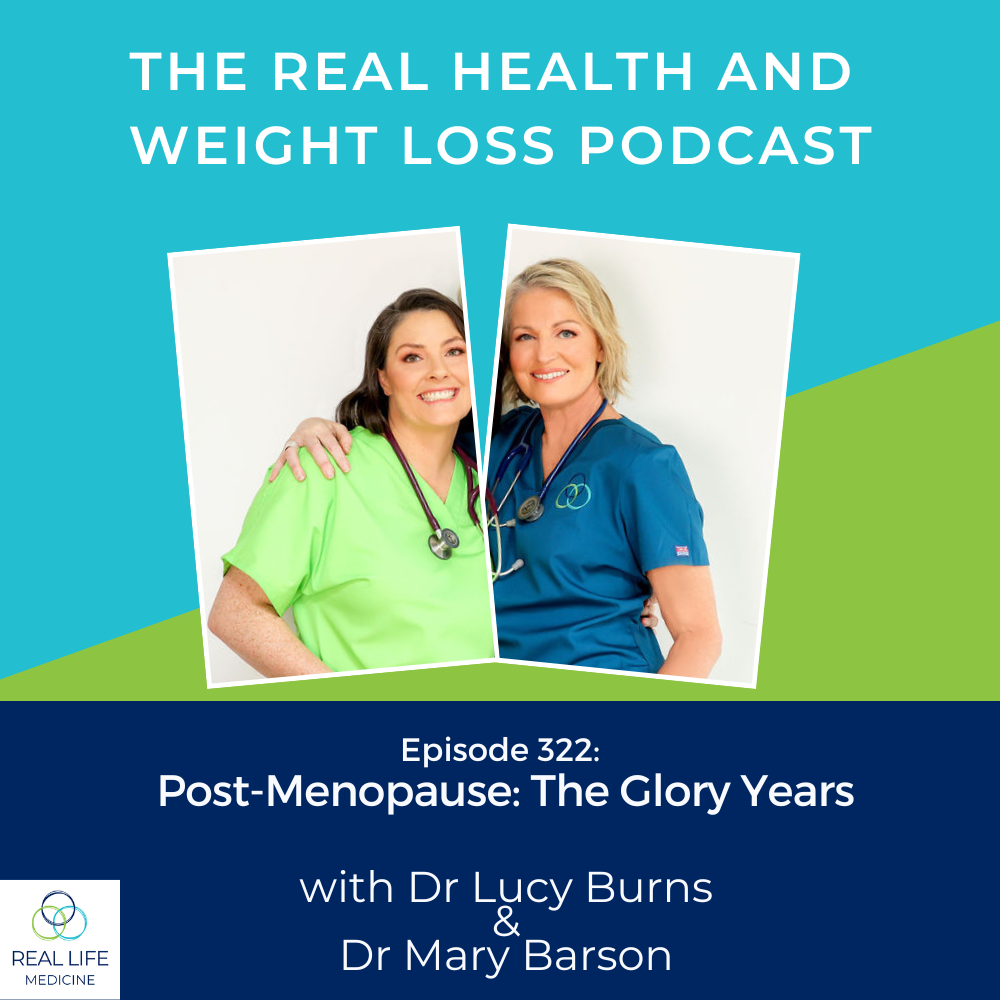

POST-MENOPAUSE: THE GLORY YEARS
One of Australia's Most Popular Podcasts with Hundreds of 5 Star Reviews

Grab your FREE Ebook copy now!
Have you struggled to lose weight and keep it off?
Start your journey to boost metabolism and transform your body into a fat-burning powerhouse.
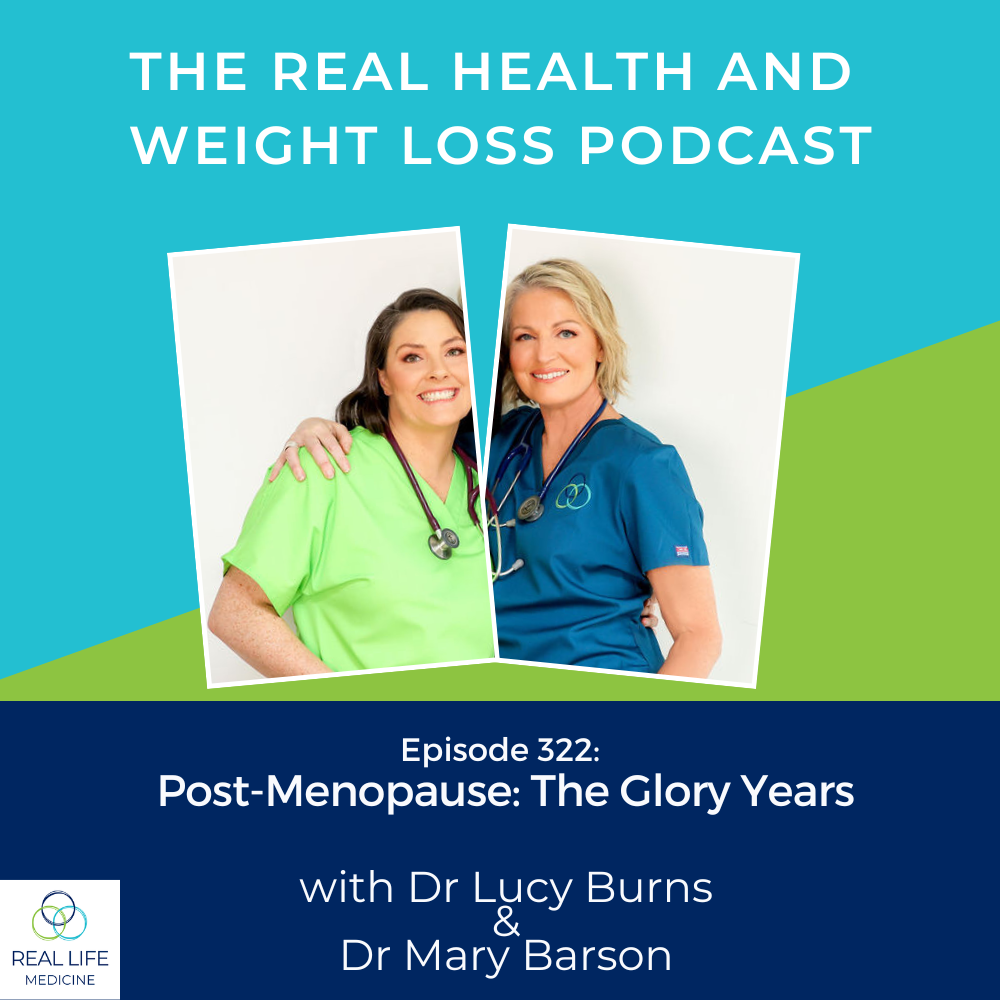
Episode 322:
Show Notes
This episode features Dr Mary Barton and Dr Lucy Burns discussing ageing, menopause, and the mindset shifts needed to thrive in the postmenopausal years, which can span 30 to 40 years of life.
Key Points
- Life in thirds: Dividing life into under-30, 30-to-60, and over-60 highlights that the menopause transition (lasting up to 10 years) sits in the middle third but is relatively short compared with the 40-odd years that can follow it.
- Metabolic shift after menopause: Pre-menopause, oestrogen is protective, and men outnumber pre-menopausal women for metabolic syndrome. After menopause (average age around 51), that flips, with more women than men developing metabolic syndrome, driven by increased visceral fat, insulin resistance, and cardiovascular risk.
- Stress and visceral fat: Managing stress is highlighted as a top lever for metabolic health post-menopause, since cortisol and HPA-axis activation drive the accumulation of pro-inflammatory visceral fat, which in turn worsens insulin resistance.
- Neuroplasticity and mindset: The brain's ability to rewire thought patterns means it's never too late to change habitual stress reactions; small daily moments of calm and more helpful thought patterns can meaningfully support metabolic health.
- HRT/MHT is not for everyone: Some women use hormone therapy, but many can't or choose not to, especially older women who missed the window when better formulations became available. For them, doubling down on lifestyle factors is the practical path forward.
- Society and ageing: The hosts discuss how Western society glorifies youth and stigmatises ageing (including how "senile" shifted from a neutral medical term to a slur), contrasting this with cultures that revere elders.
- Appearance and self-worth: They explore the tension between rejecting appearance-based self-worth and still taking pride in grooming, suggesting personal care can be a marker of self-respect rather than vanity, so long as it doesn't tip into obsession.
- Leaning into wisdom: Both doctors encourage listeners to embrace the "glory years" of postmenopausal life through curiosity, lifelong learning, and prioritising the six S's, sustenance, sleep, and stress management, alongside being a bit more selfish with self-care after decades of prioritising others.
- Next episode: The podcast is starting a new series on mindset, described as the key skill that helps people actually follow through on the health behaviours they know they should be doing.
Work With Real Life Medicine
For a step-by-step approach to improving metabolic health in perimenopause, menopause and beyond, check out My Metabolic Action Plan. This doctor-led comprehensive programme gives you
Strategies to improve metabolism
Skills to develop mindset
Tools so you will implement!
Episode 322:
Transcript
Dr Mary Barson (00:05) Hello lovely friend, I am Dr Mary Barson.
Dr Lucy Burns (00:09) And I'm Dr Lucy Burns.
Both (00:11) We are doctors, weight management and metabolic health experts. We are the creators of My Metabolic Action Plan, your two-step map to real health and weight loss, which is in fact the name of this podcast. Join MyMap now at rlmedicine.com.
Dr Lucy Burns (00:29) Good morning, lovely friend. Happy Tuesday. Dr Lucy here with the gorgeous Dr Mary. How are you, my friend?
Dr Mary Barson (00:36) I am very well, lovely Dr Lucy. On the weekend, I attended a dancing competition where my daughter danced in four different comps. And it was wonderful seeing all these clever young people on stage, dancing and singing and being entertaining. And they were all young people. There was no one over 30 on that stage. And as I was watching and enjoying this, I was reflecting on the fact that I am no longer young. And that's totally okay. It's just what it is. And I am, you know, going through this transition of, you know, becoming an elder, really. I'm not saying I'm old, but I also don't think it's bad to be old. But it is a change. It definitely is.
Dr Lucy Burns (01:22) Oh, absolutely. I remember, and this is a long time ago now, because my youngest daughter is now 22. But I remember when she was one and I went back to work. And my first patient for the day was a young guy. And he had the same date of birth as my daughter, obviously different year, but the same, you know, day and month. And I've said to him, "Oh, you've got the same date of birth as my daughter." And he goes, "Really? Same year and everything?" "No, no, she's one. She's one. How old do you think I am?" And suddenly, again, there's this perception, isn't it? Age is, there's perception around age. And I think, you know, young people, depending on how young they are, I think anybody over 20 is old. And if you're, if you're 85, then you probably think anyone under 70 is young.
Dr Mary Barson (02:12) I had a little toddler at my son's daycare come up to me the other day, and I was looking for my son. And he came up to me and said, "Hello, who's grandma are you?"
Dr Lucy Burns (02:26) Yeah. And you know, and maybe that was age, or maybe he is always picked up by his grandma.
Dr Mary Barson (02:32) So I didn't take it personally, but it was funny.
Dr Lucy Burns (02:38) Absolutely. So I think, you know, ageing is interesting. And you know, the average age these days, let's call it 90, give or take for women. So you can almost divide your life into the under 30, between 30 and 60. And then over 60. Or, I mean, we used to have a little phrase of BC, which was before children, and AC, after children. But you could also do BM, before menopause, and AM, after menopause. So, you know, there's lots of different markers of life where we can do befores and afters, if you like. But the thirds is useful. And the menopause transition definitely is in that middle third. But the thing I think to think about, God, how many ways can I say thing? The thing to think about is that the menopause transition is, you know, an upheaval and can be absolutely terrible for many, many women. But it's relatively short compared to your whole life. Now, again, you know, the longest transition is roughly 10 years. And people go, "Oh, that's long." And it is, it is long. But if you, you know, go through menopause, and you're finished at 50, and you're living till 90, then you've got 40 years AM. Yeah, that's right. Yeah. After menopause. And so we need to be talking about this. So for the women who have transitioned, who are post-menopausal, you know, what does life look like for you? What is your health look like for you? And what are the things that are different for you as a post-menopausal woman compared to a pre-menopausal woman?
Dr Mary Barson (04:28) Because they are different. And it's different for, for your metabolism, for your bones, for your muscles, for your brain, and also for our place in society, and perhaps our self-identity as well. It does change. And that is not a bad thing, necessarily. And it's an unavoidable thing. So I think it is good to get our mindset as helpful as we can be to embrace these changes and make the most of them.
Dr Lucy Burns (04:56) Yeah, absolutely. And I think there's a lot of media around, you know, the doom and gloom of menopause. There are also some really good benefits, particularly if you've had mood disorders related to your periods, to your cycle. Cyclical mood disorders finish when there's no longer a cycle. Now, you know, again, people get menopausal mood disorders and they're often separate. But the actual pre-PMDD, so for the women who suffer often significant mood disorders related to menstruation, that's gone. So it's not always terrible. It's not always doom and gloom. But I guess what I would say is that menopause is permanent. Like the changes that do occur with our metabolic health, bones, muscles, etc., they're permanent. So we do often need to be proactive about the things that we do for our health.
Dr Mary Barson (05:53 ) And I think that's extremely important because in that pre-menopausal state, the relative abundance of estrogen in our system is quite protective. And to take something like metabolic syndrome, which is not exactly a diagnosis, but it is sort of a cluster of conditions related to poor metabolic health, which is increased waist circumference, hypertension, low HDL, increased triglycerides. And it's all associated with a significant increase in cardiovascular disease. Men outnumber pre-menopausal women with metabolic syndrome. So more men than pre-menopausal women have it in that age group. But then when we get in, when women become post-menopausal and we're in the age group where women are post-menopausal, which is on average about 51 years, but it is different for every single woman. Then in this age group and moving onwards, then there is more metabolic syndrome in women than there is in men. So it's this big shift in our lives.
Dr Lucy Burns (06:55) Yeah, absolutely. I mean, there is, you know, there is no doubt that estrogen is extremely protective for, as you said, metabolic disease, cardiovascular health, brain health, bones, muscle, blah, blah, blah. We've been banging on about that, but it does disappear. And some women can use and do use HRT or MHT as it's now called, but not everybody does. Not everybody wants to, not everybody can. And for some women, particularly if they're, you know, in their sort of later sixties, well then they missed out because it was in the phase of medicine where the type of HRT that was offered or available was perhaps not that helpful. So basically the whole HRT was tarred with a brush that labelled it as being unhelpful and potentially harmful. So for all of those women, you know, we need to talk about, well, what do you do? The words of Reese Witherspoon, what do we do now? And here's the thing, this is where we double down on some of our lifestyle things. You know, there's no point wringing our hands about, I can't have oestrogen, or I'm not taking oestrogen, or it's too late for me to take oestrogen. We can just go, okay, well, what are the things that are in our control?
Dr Mary Barson (08:14) And there's lots. The one I would actually like to start with is stress management. Because one of the main problems metabolically that happens post-menopause is this quantitative and qualitative change in our fat tissue. So we're more likely to have more fat tissue, but also to have more of the dangerous visceral fat tissue, the fat around our organs, that intra-abdominal fat. And that fat is pro-inflammatory, that is the fat that contributes to insulin resistance, that is also driven by insulin resistance and create this big sort of vicious cycle that is impacting our metabolic health. And it's also upregulated by the HPA axis in our brains, which is our adrenal axis, which is our stress and our cortisol. And if we can take steps to manage our stress and to help regulate the stress pathways, if you like, in our body, then we can make meaningful changes to our metabolic health. And that's especially important post-menopause. So I think that that is one that's really important.
Dr Lucy Burns (09:24) Absolutely. And the wonderful thing about brains, like I love the brain, the brain has this process called neuroplasticity. We've spoken about it before. It is the ability to rewire your thought processes. So something that is really helpful to know is that it's never too late to do that. It's never too late to be able to change your beliefs, your thought patterns, and the habits that we can develop because thoughts can be habitual as well. So we can have habitual thoughts and habitual reactions to particular stressors. And that's not to say those events or circumstances aren't stressful, but if we always have the same reaction to them, like we can take active steps to change that.
Dr Mary Barson (10:10) We can. And take little active steps to just impose a few more moments of calm in our day as well. Practice letting go of the things that we can let go of, although society, from a social point of view, typically women in this space of their lives are also busy with lots of demands on us, which is potentially not very helpful, but letting go of what we can, moments of calm when we can, and practicing more helpful thoughts is going to help regulate that stress, which is literally going to help regulate our visceral fat tissue as well.
Dr Lucy Burns (10:43) Absolutely. And a lot of this comes down to mindset, which we're going to talk a lot more about next week. So for those of you who are interested in mindset, stay tuned for next week's episode. But I think thinking about menopause and this post-menopausal period, which for women is somewhere between 30 or 40 years. So it's a significant amount of time and it doesn't have to be hideous. I think we've got this idea that the post-menopausal period is terrible, that we're just washed up, wrinkly old has-beens or whatever it is. And I think there's reason why we have maybe internalised that and look, society fears aging and glorifies youth. Not, sorry, I will caveat that with Western society fears aging and glorifies youth. There are plenty of cultures that actually appreciate their elders and have respect for their elders. We're not so good on that.
Dr Mary Barson (11:51) Yeah. And that I see lots of beautiful women that I work with, lots of beautiful women that I interact with that really do worry about being old and looking old. And also talking to my friends recently about how it's interesting that you become more invisible as you get older and that young women, we often got a lot of attention. Some of it was often unwelcome, negative attention. We didn't necessarily want it, we got it. And that we were created, we were just became points of interest in society just because we were young and decorative. And now we're older, that has gone. But I'm not really sure that it is replaced with federation of our wisdom, federation of our role in society necessarily. And I think that that is a problem in our current society, which makes us want to grapple to look young and to be young and to fear aging and to not like the fact that we're getting old, even though getting older is unavoidable.
Dr Lucy Burns (12:58) Yeah. Well, the only other option is death. So if you want to stay young, you have to die young. That's it. There's not much of a way to live your life when you're dead. So we want to be thinking about, okay, what are the options here? And, you know, there's a lot of money in the anti-aging space. People, companies are making money out of that. And I think the tricky bit is, and I've been thinking a bit about this just myself recently, about this difference between aging, beauty, aesthetics, self-care, personal grooming. How do you find a little bit of peace in that space? Because on one hand, my brain's going, well, you know, I'm not falling for this aesthetics trap where everything's primped and plumped and smoothed. And I'm not doing any of that. To the point where then my brain goes, oh my God, Lucy, look at your eyebrows. They're sparse and what's happened to them? You need to fix these up. And I'm sort of then going, well, how do I do that? You know, how do you navigate that space? It's quite tricky.
Dr Mary Barson (14:15) Yeah, it is. It's finding your balance. And I almost never wear makeup to work. And that's not really by design. I actually like makeup. I think makeup is fun and creative and useful, but it's just, I don't have time. I spend 45 minutes in the morning getting my kids ready. And then I spent about three minutes getting myself ready, brush my teeth, put on my clothes and go. I actually like just tying my hair back in a ponytail at the car park at work, having sort of brushed it a couple of times at traffic lights. And that's it. And I think that I could do better. And I think that I might, would possibly be better if I paid a bit more attention to my presentation. But by the same token, I don't feel the need that I have to. I have to be beautiful to be valuable, but it's also okay to take pride in your appearance.
Dr Lucy Burns (15:02) Yes. And I think you've just hit the nail on the head there too, because I was a bit the same up until about yesterday where I decided enough's enough. But yeah, I was, yeah, you know, we went out and we just had a holiday in Noosa, which is a bit fancy. We went out to fancy restaurants. Honestly, I was schlepping there in my tracksuit pants and no makeup and sort of saying, oh, well, it doesn't matter because, but sometimes what happens is that when we take no pride in our appearance, we're sending a message to ourselves that actually we don't matter. We're not important. We're not important enough to brush our hair.
Dr Mary Barson (15:37) Yeah. My kids are way more important than me, which I think is literally what my brain believes. So there is that.
Dr Lucy Burns (15:43) Yeah. And some of that, and some of that of course is, you know, a DNA survival because we are supposed to rear our young so that they can live long enough to reproduce and, you know, perpetuate the human race. But all of that aside, I think that, you know, this morning I did my makeup, I've done my hair. It actually did take me about 40 minutes. And again, I'm a bit slower than probably the average person, but I have never, or recently I've not been budgeting that time into my daily time allowance. So if you don't make time, then there is no time.
Dr Mary Barson (16:21) Totally. I went to Mecca the other day to buy some more stage makeup for my dancey daughter. And we needed to, like, look at ways to make the makeup last longer. And it's lovely, helpful, uh, you know, retail assistant at Mecca looked at me and goes, "Okay, so what's, what's your skin routine and, and what kind of makeup primer do you use?" I was like, little voice in my head said, "Absolutely nothing. I washed my face in the shower." That is all.
Dr Lucy Burns (16:47) That is all.
Dr Mary Barson (16:59) Yep.
Dr Lucy Burns (16:50) You know, there's no right or wrong when it comes to appearances and personal grooming. It's everyone has like their own threshold of what is acceptable to them. And so what I would sort of think about there is what level tells yourself that you value yourself and that you have self-respect, because if there's a level and you're not achieving that, then, and you're sending yourself a message, "Well, actually, not important enough." There's other things, other people that are more important. It's not important that I brush my hair properly, or it's not important that I have clothes that fit, or it's not important that I, I don't know, whatever it is, feel good about myself. Well, then what happens is you spiral down and you don't do anything to look after yourself.
Dr Mary Barson (17:39) That's an, it's an interesting concept that you bring that, to an extent, the effort we put into our outward appearance is a marker of how we value our inward worth. I think that's an interesting thing to ponder. And it is like getting that balance because I also don't believe that it's healthy to yet spend enormous amounts of time, money and effort trying to change that, which can't easily be changed. I, the fact that we're aging, but also we're allowed to feel beautiful.
Dr Lucy Burns (18:14) Absolutely. And this is it. This is the little bit, that little path that's hard to navigate because you are right. It's a pendulum swing too far the other way. And all of a sudden your entire self-worth is, you know, about what you look like in the mirror to yourself. And that, you know, if you're not wearing makeup or you're not having, you know, styled your hair, that somehow you're ugly and hideous, and that's not true either. So definitely it is this pendulum of extremes. No self-care is fairly indicative, or no, that, you know, that you don't respect yourself too much kind of means that you're not happy with your, or that your worth is tied up with your appearance, which to some extent it is for many of us, but there's this sort of little, yeah, just this path that's hard to walk. And it happens with lots of parts of our lives, doesn't it? And even things like looking after our health and our weight management, that's like the pendulum as well. No care in you, you eat whatever you want or need or have and your health declines, but obsessing and, you know, your life becomes miserable. And in fact, it can become a whole eating disorder. So there is, there's this whole balance.
Dr Mary Barson (19:31) And it's fair to say that society does not make it easy for us as we age.
Dr Lucy Burns (19:38) No, definitely not because it's telling us that old is bad and it's used as a slur for a lot of things. And in fact, we were talking about how the word senile was initially a medical term and it just meant old or aged, and senile dementia meant old age dementia. And now senile is used as a kind of indication that you're losing your marbles or you're developing dementia. And it's like, oh, what, are you senile? It's like, well, why is that bad?
Dr Mary Barson (20:15) Senile just means older. All right. So basically biology is ganging up on post-menopausal women. Society is ganging up on post-menopausal women. What do we say? And as we are women, you know, navigating this or entering this phase of ourselves, what do we say to all of those beautiful women out there listening today?
Dr Lucy Burns (20:35) So I would lean into our wisdom. This is the bit that happens. We are wise. We're wise now. Like, I have 58 years of lived experience. Now, admittedly, I can't remember the first few years, but a lot of lived experience where I've made mistakes, where you've learned from those mistakes. And I think one of the things that is helpful at any age is the power of learning and always keeping your mind curious and flexible and adaptable. Because I think something that can happen as we age is that we become a bit more rigid. And that again, that doesn't always help us or help the people around us. So being flexible, open, curious, and learning is the thing that keeps you in touch, I guess, with the world. Because that's the other thing that happens is, you know, the world is moving along, as we all know, rapid rates. My kids still laugh that, you know, I grew up without a mobile phone. How did your mum talk to you? She didn't. She just yelled out the back door, "Time to come home." So technology is rapid. And rather than just deciding you can't do it, you know, embracing it or learning it or having a crack is useful. I think that, you know, thinking about those lifestyle factors that we always talk about, the six S's of your sustenance, your nutrition, it matters, it's helpful. You know, prioritising your food as much as you can is useful for bones, muscle, brain. As you said, managing your stress, also useful, very useful for metabolic health and brain health, prioritising sleep and really being a little bit more selfish. That probably jars for a lot of people because we've spent all our lives being helpful and kind and considerate. But actually, I think it's time. You know, if you're in that postmenopausal, particularly postmenopausal, is your time. It is your time. It's your glory years. Time to be glorious.
Dr Mary Barson (22:49) Yep. They're yours. They're your life. Own it. Own it.
Dr Lucy Burns (22:53) Yeah, you deserve it. You can put on a bit of lipstick if you want to, if that makes you feel good. You don't have to, but you can, you know, go to the gym, play golf, do the things that make you happy and know that yes, we are getting older. It's normal. Let's normalise aging and not have this thing that became, you know, there was this, what's that saying, you know, "Oh, a woman doesn't share her age." It's like, what bullshit is that? Like, honestly, if you're 72, be 72 loud and proud. It's nothing to getting old. I mean, it's funny, isn't it? But we have developed like shame around getting old.
Dr Mary Barson (23:37) That's right. Yep. I feel like I am transitioning into being an elder, and I am leaning into that and just deciding and testing out what that means for me. I think it's beautiful.
Dr Lucy Burns (23:50) It's beautiful. Yeah, absolutely. I think getting old is glorious. There are plenty of people who wished their loved ones could get old. Okay. So having a think about that and embracing getting older with the wisdom that it comes. And yes, I know society is still going to tell you that you're worthless because you've got wrinkles or that, you know, that wrinkles are terrible or that your turkey neck is like, you know, the worst thing ever. But as we all know, that's just, that's just marketing to sell a product, to make money. And you know, we can chuck all that in the bin.
Dr Mary Barson (24:29) That's right. We are fine just the way we are.
Dr Lucy Burns (24:34) Absolutely. All right. My lovely women out there listening. Yes. Embrace getting old. It is something that is to be valued and, you know, I think revered might be a good word.
Dr Mary Barson (24:48) Wise words. Lovely, wise woman.
Dr Lucy Burns (24:51) Indeed. As are you. All right, friends, we will come. So next week, again, we're starting a series on mindset. So if mindset has been something that you feel, you know, you might need a little bit of help with, and you know, how do you know if you need help with mindset? Well, mindset is the thing that helps you do the thing that you know you could be doing or should be doing to look after yourselves.
Dr Mary Barson (25:0120) Yes. See you then
Dr Lucy Burns (25:14). Indeed. All right. See you then. Bye now.
Dr Lucy Burns (25:18) The information shared on the Real Health and Weight Loss Podcast, including show notes and links, provides general information only. It is not a substitute, nor is it intended to provide individualised medical advice, diagnosis or treatment, nor can it be construed as such. Please consult your doctor for any medical concerns.